How Many People Are Buried Here?
First in a series of Occasional Papers about Eastern Cemetery in Portland, Maine
by Ron Romano
© 2015
Figure 1.
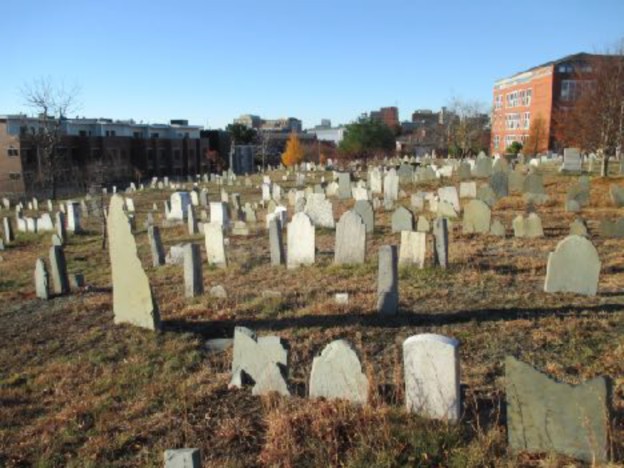
We will never know the exact number of people who claim Eastern Cemetery as their final resting place. Sources vary greatly in their estimates of the number interred, from 4,000 to 7,000. In an effort to zero in on a more exact number, I conducted two exercises: 1) I analyzed samples of population and mortality rate data for Portland during years the cemetery was the sole burying ground on the peninsula, and 2) I re-populated the cemetery using the plot map first drawn by City Engineer William Goodwin in 1890. This paper summarizes my efforts and answers the question with a current estimate.
Contents
- Introduction
- Exercise 1: Analysis of population and mortality in Portland
- Exercise 2: Re-populating the Cemetery
- Conclusion
- References
Introduction
It’s something we’re often asked during a guided tour: “How many people are buried here?” While I’m tempted to reply, “All of them!” the real answer depends on which source you prefer to use. Here are some examples:1
| Number | Source |
|---|---|
| 2,744 mapped plots | Jordan’s 1990 revision to the 1890 Goodwin survey map |
| 3,848 “named graves” | Longfellow Garden Club bronze marker off Funeral Lane, 1975 |
| 3,920 interments | Record of Interments, Bill Jordan, 1978, in Maine Historical Society (MHS) collections |
| 4,000 “interred” | Spirits Alive website |
| 4,000+ “stories to be told” | Spirits Alive 2015 brochure |
| 4,136 “gravestones, monuments, grave sites” | Goodwin’s survey of 1890, per Bill Jordan |
| 6,738 interments | Portland Cemetery Records database |
| 6,832 interments | Find a Grave website for Eastern Cemetery |
| 7,000 “about 7,000 records” | Bill Jordan’s 2009 Burial Records, 1717–1962, of the Eastern Cemetery, Portland, Maine |
In some cases, these sources are comparing apples to oranges. For example, the number of “mapped plots” on the survey doesn't take into consideration the number of people known to be buried in a tomb. While the tomb is counted once as a “plot” in one source, the 25 people in that tomb are counted as 25 interments in another.
Other factors complicating the analysis include (but are not limited to):
Unmarked and under-marked graves. From the mid-1600s to the mid-1700s, settlers on the peninsula had plenty to worry about, so a carved grave marker was not likely front of mind. Basic survival issues, conflicts with natives, and lack of a local stone carver meant that the dead were simply put in graves at the “Burying Ground” and marked with a piece of found stone or wood (under-marked), if at all (unmarked). Mass graves may have been used during severe disease outbreaks. Specific groups, such as the Quakers and African Americans, were often buried in unmarked graves for religious or economic reasons.
Cenotaphs. Eastern Cemetery has a good number of cenotaphs, so the marker appears on the map and is counted on the plot survey, but the person is not here. Henry Wadsworth (1804) and Alonzo Stinson (1861) are examples.
Lack of record-keeping. For its first 150 years, Portland’s Burying Ground received the dead without a known central repository for recording burials.
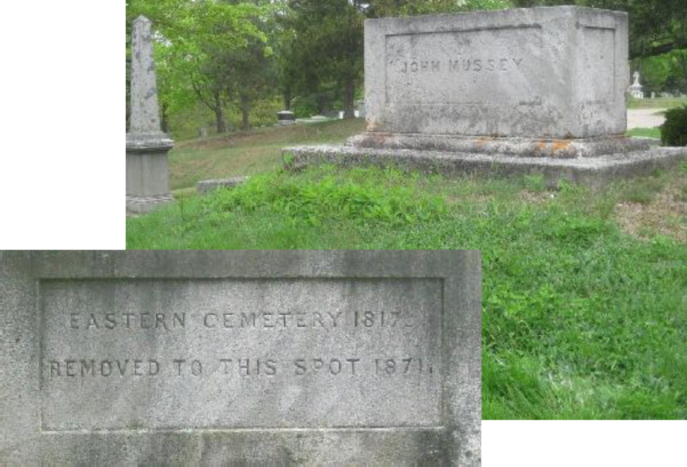
Mass exodus. Once Evergreen Cemetery opened in the mid-19th century, many people purchased lots there to accommodate their large families. It was not uncommon to remove loved ones from their graves at overcrowded Eastern Cemetery for re-burial at Evergreen.2 One such example is found below for John Mussey, whose grave marker at Evergreen tells the story.3
Figure 2.
Probable loss of historic burial land. Access to the burying ground was originally from the harbor side of the hill.4 Following the mass destruction of Portland during the 1866 “Great Fire,” the city extended Federal Street east to Mountfort Street by removing the “front” of the hill and erecting in its place the massive stone retaining wall that survives today. There is debate among historians and the city regarding the removal of human remains during this construction project. But given the large amount of land involved, it seems likely that some remains of early settlers would have been taken away.
Strangers’ grounds. While the specific locations of the plots reserved for the paupers, friendless and unknown dead of Portland are not found on any map, we know from Jordan that the city authorized 2 bodies per plot in these sections. These folks may not have contributed great numbers to the overall total interred, but help explain the inability we “students of the cemetery” have in finding an exact count of subterranean residents.
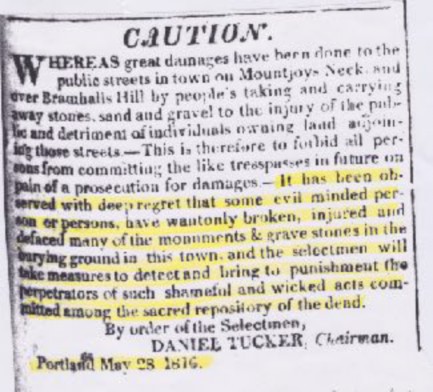
Loss of markers. Whether by vandalism, theft, accidental damage, or natural deterioration, there has been a significant loss of grave markers over the years. 200 years ago, this article appeared in the Eastern Argus:
Figure 3.
- CAUTION.
WHEREAS great damages have been done to the public streets in town on Mountjoys Neck and over Bramhalls Hill by people's taking and carrying away stones, sand and gravel to the injury of the public and detriment of individuals owning land adjoining those streets. This is therefore to forbid all persons from committing the like trespasses in future on pain of a prosecution for damages. It has been observed with deep regret that some evil-minded person or persons, have wantonly broken, injured and defaced many of the monuments & grave stones in the burying ground in this town, and the selectmen will take measures to detect and bring to punishment the perpetrators of such shameful and wicked acts committed among the sacred repository of the dead.
By order of the Selectinen,
DANIEL TUCKER, Chairman.
Portland May 28, 1816.
Exercise 1: Analysis of population and mortality in Portland
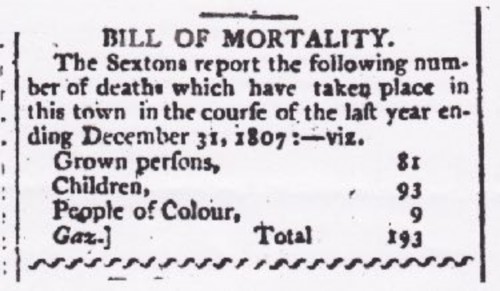
My first attempt to answer the question that’s the topic of this paper was to simply add up the number of people known to have died each year in Portland. However, annual mortality figures are not available for much of the first 150 years of the cemetery’s history, and a simple summing of all of the deceased isn't possible. By the early 1800’s, annual reports such as the one below were published in the newspaper. This one is from the January 7, 1808, Eastern Argus:
Figure 4.
- BILL OF MORTALITY.
The Sextons report the following number of deaths which have taken place in this town in the course of the last year ending December 31, 1807:-viz.
Grown persons, 81
Children, 93
People of Colour, 9
Gaz-] Total 193
Next, I decided to use population and mortality data to assign an average value of “death per 1000” (or 100 for the earliest years of settlement) and then apply it to the known population through about 1800, when mortality numbers began to be regularly published. I selected the 1770s decade, since values for both population and mortality were found.5 Here are the results from a simple calculation:
| Year | Deaths per 1,000 |
|---|---|
| 1772 | 18 |
| 1773 | 37 |
| 1774 | 20 |
| 1776 | 7 |
It seemed odd that the death rate was ten times greater in 1773 than in 1778, and I began to suspect some inconsistencies in reporting. For example, population statistics were reported for Portland Neck, but death and burial statistics may have extended beyond the Neck, to Stroudwater Cemetery, which was active at the time. Other factors may be a particularly challenging disease cycle in 1772–1773 resulting in a higher than usual death rate. Could fluctuating population during the American Revolution and aftermath also have played a role?
Extracting an “average deaths per 1000” value to apply to known population figures over 150 years or so seemed unreliable, at best, and after some thought, I decided that this, too, was proving to be of little help.
Exercise 2: Re-populating the Cemetery
What seems to be common knowledge is that by the end of the 18th century the town’s burial ground (then just sections C through L on the current map) was overcrowded —if not full—and that so many graves were unmarked it was not uncommon for a grave- digger to find someone else already occupying the spot he was digging. This led to the need for expansion and the purchase of land from Reverend Smith in 1795. That purchase (sections A and B on the current map) nearly doubled available burial space.
Soon after, the construction of the 86 underground tombs began in section A (see below). Each tomb was designed to hold up to 30 people—in stacks—and therefore provided even more burial capacity.6
Figure 5.
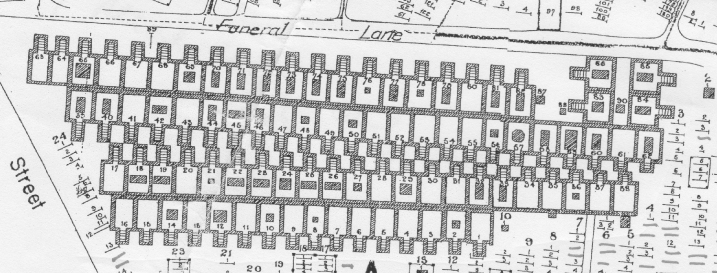
Assuming 30 people per tomb, total capacity in the Section A tombs is 2550. Not all tombs were filled, however. According to the 1978 “Record of Interments,” those tombs with the greatest number of interred are:
- Tomb A-69 with 28
- Tomb A-29 with 26
- Tomb A-72 with 24
Had this field of tombs been laid out as the rest of the burial ground (that is, one person per plot), total capacity of the area would have been approximately 600. So the tombs allowed for up to four times as many burials than if this area had been left an open burial field.
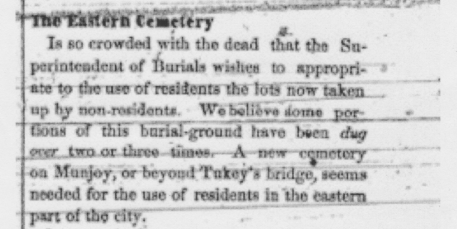
Even with the addition of Sections A and B in 1795, and the Section A “high- capacity” tombs, the cemetery quickly filled. To help meet demand, Western Cemetery opened in 1829, and Evergreen (in the town of Deering, but annexed to Portland in 1899) opened in 1854. Still, there was a problem, as seen in this article from the Portland Transcript on May 22, 1858.7
Figure 6.
- The Eastern Cemetery
Is so crowded with the dead that the Superintendent of Burials wishes to appropriate to the use of residents the lots now taken up by non-residents. We believe some portions of this burial-ground have been dug over two or three times. A new cemetery on Munjoy, or beyond Tukey's bridge, seems needed for the use of residents in the eastern part of the city.
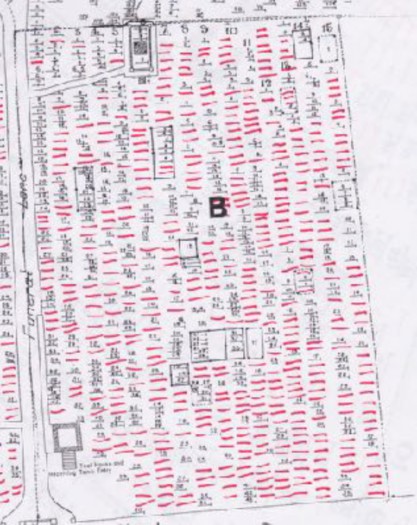
This second exercise was a relatively simple, yet time-consuming, task. Starting with the assumption that unmarked plots are in fact occupied, I re-populated the open areas of the cemetery section by section, line by line.
Next, you’ll find a “before” and “after” for section D (figure 7), one of the smaller sections of the older part of the cemetery. You’ll find the same for section B (figure 8), one of the newer sections, where grave plots were laid out in a more orderly, linear fashion.8 Note that the black, numbered lines are where grave markers were found and 8 mapped during the original 1890 plot survey; the red lines are my additions to the section plot maps.
Section D: Before and After
Figure 7.
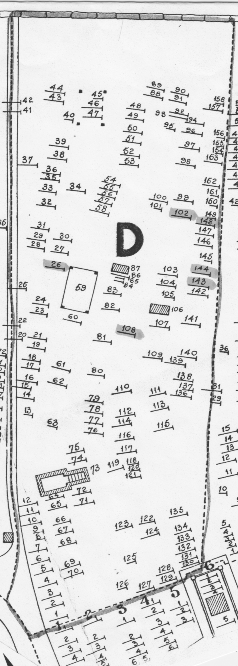
Figure 8.
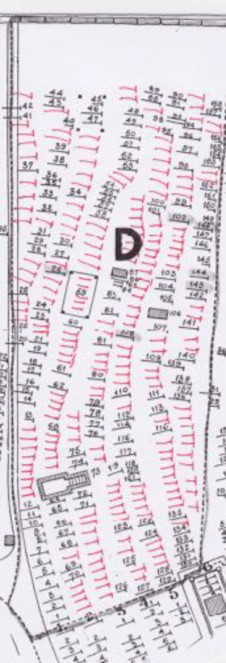
Note the upper portion of this section remains unpopulated on these maps. There is an approximate 15- foot wide vacant space that runs the entire length of the cemetery’s back fence along Federal Street. It appears that when the city extended Federal Street and built the retaining wall, they back-filled this area (to create a walkway?) If, in fact, early burials extended down the original slope of the hill, no evidence of that exists today, and this open space seems far too orderly in its absence of grave markers, given all of the graves immediately adjoining it.
Section B: Before and After
Figure 9.
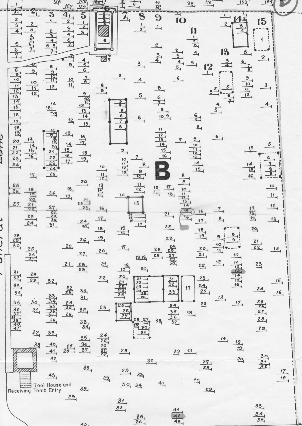
Figure 10.
Re-population results by section
This table shows the results of the re-population effort. For “mapped plots” and “plots drawn by hand,” the assumption is one person per marker. Actual recorded number of people interred in the underground tombs is provided for those sections where underground tombs exist.
| TOTAL | 2,760 | 3,498 | 6,258 | 697 | 6,955 |
|---|---|---|---|---|---|
| A | 563 | 455 | 1,018 | 647 | 1,665 |
| B | 474 | 430 | 904 | — | 904 |
| C | 247 | 332 | 579 | — | 579 |
| D | 157 | 198 | 355 | 1 | 356 |
| E | 92 | 114 | 206 | 3 | 209 |
| F | 180 | 203 | 383 | 36 | 419 |
| G | 154 | 164 | 318 | 7 | 325 |
| H | 188 | 197 | 385 | 2 | 387 |
| I | 213 | 291 | 504 | — | 504 |
| J | 227 | 319 | 546 | 1 | 547 |
| K | 173 | 323 | 496 | — | 496 |
| L | 92 | 472 | 564 | — | 564 |
Conclusion
As stated at the outset, it’s impossible to know the exact number of people buried at Eastern Cemetery. Many variables are at play and move the estimate higher or lower.
But this exercise gives us the approximate capacity of the open landscape: 6,258.
If we are to believe that some graves in the original burial ground were used two to three times (Figure 6), or that human remains were removed when the hillside was carved away to allow for the extension of Federal Street (Jordan and others), then this capacity is understated. But by how much? 5%? 10%?
The fact that some monuments are cenotaphs, and the fact that some people were removed to other burial grounds in the second half of the 19th century brings the actual number of burials back down. Again, by how much?
The purpose of this paper was to consider a variety of variables and find a more reliable number within the currently-used range of 4,000 to 7,000. All things considered, this analysis confirms the challenge of ever finding a “good” number, but does suggest that a reasonable estimate of the number of people buried at Eastern Cemetery is 7,000.
References
Description and PDF version: How Many People Are Buried Here?
1The Master Plan for the Eastern Cemetery written by Chicora Foundation in 2011 is silent on this. back to text 1
2 Early grave markers from the shop of Bartlett Adams (pre-dating the establishment of Evergreen Cemetery by 40 years) are found at Evergreen. Some families recycled these stones when moving bodies from Eastern to Evergreen. back to text 2
3 John Mussey’s name does not appear in Eastern Cemetery records, despite our knowing that he was originally buried there back to text 3
4 The “back” of the burial ground was originally along the section of Funeral Lane that runs parallel to Congress Street, from the Mountfort Street gate to the flagpole to the back corner of North School. Today, of course, we call the front of the cemetery the Congress Street gate. So the cemetery’s front-to-back orientation has become completely reversed over time. back to text 4
5 Sources are the well-known Portland histories by Willis and Elwell, and the Portland City Guide. back to text 5
6 Ten other underground tombs are found in the original burial ground, 4 in section F and 1 each in sections D, E, G, H, and J. Given that records show first dates of burial of 1777 (Tomb E) and 1795 (Tombs D & F), I suspect these tombs were constructed before the 86 Section A tombs. back to text 6
7 It’s an interesting concept — digging up non-residents to allow East-enders to be buried in their places. And it’s not the first time this idea was raised. An 1838 newspaper article called for a similar solution to the overcrowding of the burial ground. back to text 7
8 It’s important to keep in mind that, especially in sections A & B, some families purchased plots in the open ground but may not have used all spaces in those plots. back to text 8