The Catholic Plots
Second in a series of Occasional Papers about Eastern Cemetery in Portland, Maine
by Ron Romano
© 2016
Figure 1.
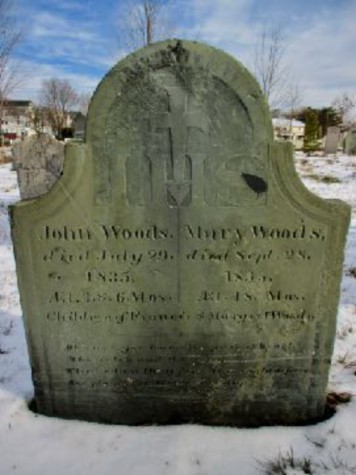
In the summer of 2016, Spirits Alive tour guide Angela Dexter found a small cluster of markers at Eastern Cemetery that were carved with the letters "I.H.S." and the Holy Cross. She knew that Eastern Cemetery had designated sections for African Americans and Quakers, but found no indication on the visitor map of a dedicated section for Catholics. She wondered if there might actually be a "Catholic Ground." This paper considers the burials for known Catholics in order to answer the question: Were Catholics segregated from the general population at Eastern Cemetery?
Contents
- Introduction
- Early Settlers
- Irish Catholics in Portland
- Burials at Eastern Cemetery
- The First Recorded Catholic Burials
- What About the Others?
- Catholic Markers
- African American Catholics
- Miscellaneous Findings—Longevity, Cause of Death, and a Research Detail
- Conclusions and Recommendation
- Alphabetical List of Known Catholics at Eastern Cemetery
- Sources
Introduction
The parcel of land serving as the final resting place for the residents of the peninsula of Falmouth (now Portland) from the mid-1660s through the mid-1830s was originally called the "Burying Ground." Once overcrowding made clear that a second cemetery was necessary, a new burying ground on Bramhall’s Hill—on the west end of town—began receiving the city’s dead. It’s around 1830 that we began to see use of the name "Eastern Cemetery" in place of "Burying Ground" and "Western Cemetery" to differentiate the two.
The Burying Ground was originally just a small area of the present southwest corner of today’s Eastern Cemetery. As the population—and the need for more graves—grew, the burying ground expanded eastward towards Munjoy Hill. In 1795, the cemetery nearly doubled in size when Rev. Thomas Smith sold land to the city to allow for much-needed burial space. Then, after the Great Fire of 1866, reconstruction of the neighborhood led to the extension of Federal Street from midtown all the way to Mountfort Street. In the process, some of the original old burying ground was carved away, and the overall size of the cemetery was reduced somewhat. Today, Eastern Cemetery occupies about six acres of the city.
Figure 2.
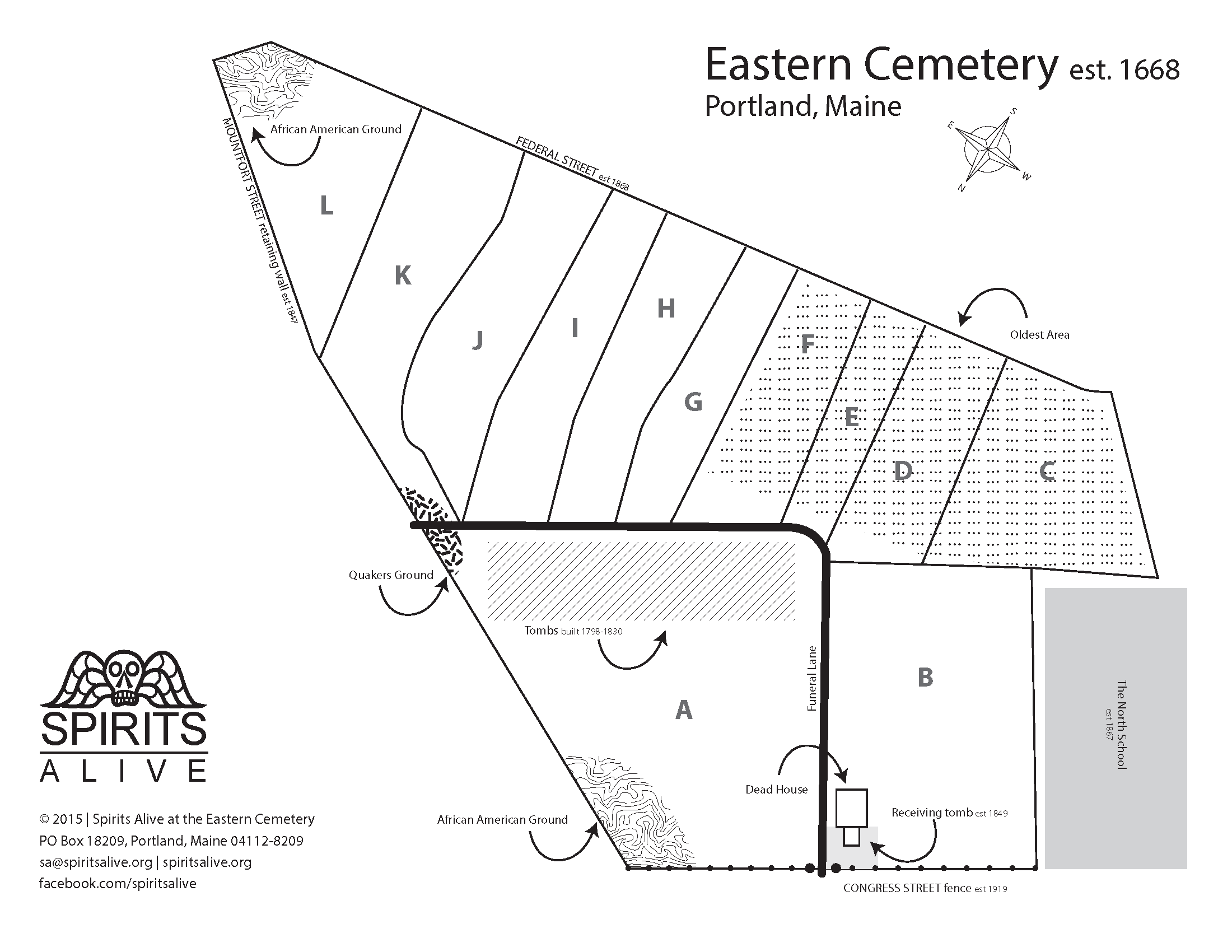
2015 Visitor Map of Eastern Cemetery: Section letters were assigned during a survey in the 1890s. The oldest graves are found in D (the waterfront side of the cemetery). Sections A and B were added in 1795.
Early Settlers
Protestant English settlers began arriving in the mid-1600s. Except for the native people still occupying the peninsula, there was little diversity in the population. This would begin to change in the 1700s, as Portland developed a maritime economy and attracted people to the rich resources of the area. People of color—some of them slaves—worked on the wharves and in the homes of wealthy whites, and Irish Catholics started to make their way here, some as indentured servants and others as free people in search of a better life. It is this group—the Irish Catholics—that is the subject of this paper.
Irish Catholics in Portland
Matthew Jude Barker has written a fine book on this subject (The Irish of Portland, Maine: A History of Forest City Hibernians. The History Press, 2014). Matt notes that the first known Irish settler was Thaddeus Clarke who arrived by around 1660, and occupied land on the peninsula until he was killed in an Indian attack in 1690. Matt writes that many more Irish settled in the area by the 1730s. He notes:
"These Irish people, due to the lack of Catholic priests, were married by and had their children christened by the local Protestant ministers. They were wise to lie low, as anti-Catholicism was rampant at the time. Irish Catholics were called 'St. Patrick’s vermin' by the Puritans, and Catholic priests and masses were outlawed by the Massachusetts Bay Colony."
Irish Catholics continued to trickle in and by the early 1800s had established a community in Portland. Barker has found record of a Portland baptism in 1798. The Portland City Guide (published 1940) notes that baptisms occurred in 1811, 1812, and 1815, by the visiting Father James Romagne. By 1822, there were 43 Catholics in Portland; they had petitioned Bishop Jean de Cheverus for their own local parish. Just five years later, according to Barker’s research, there were 120 to 130 Catholics here. And in 1828, construction of the first Catholic church began in Portland to serve the growing population. The first official Holy Mass was offered at the new St. Dominic’s Church in the fall of 1830, with a parish of about 300.
The opening of Portland’s first Catholic church occurred about the same time as the opening of Western Cemetery on Bramhall’s Hill. Eastern Cemetery was rapidly filling, and so the Western Cemetery offered some relief to the overcrowding at the city’s original burying ground. It’s no coincidence then, that a special section of the new cemetery was consecrated as the "Catholic Ground." In the collections of the Maine Historical Society (MHS) we find a roster of Irish-Americans buried at Eastern and Western Cemeteries. According to this file, the Catholic Ground at Western Cemetery received 1,304 Catholics, primarily between 1840 and 1870.
By mid-century, the Catholic Church desired its own cemetery to serve the Catholics of the area, and so a large tract of land in South Portland was purchased in 1858 for this purpose. Calvary Cemetery was quickly developed and consecrated, and began to receive the remains of Catholics. It was not uncommon in the nineteenth century for families to move human remains from one place to another, and so both Eastern and Western Cemeteries experienced a loss of some Irish Catholic subterranean residents once Calvary opened.
Burials at Eastern Cemetery
The Irish population had not yet blossomed in Portland during the time that Eastern Cemetery was most active, so the list of Catholics buried at Eastern contains far fewer names than the list for Western Cemetery. And the number, though small, is not exact. The MHS roster (created circa 2000) lists 50 people. In his book, Burial Records 1717–1962 of the Eastern Cemetery, Bill Jordan compiled all known names of those buried at Eastern, along with dates of birth and death, age, and plot locations—when known—with occasional notes such as "Catholic." I did a page-by-page review of Jordan’s list and found 49 designations of "Catholic" (the majority of those matched the MHS roster, as expected). I found that Matt Barker’s book contained another dozen Catholics who were not on the MHS roster or who were listed in the Jordan book but without the designation of "Catholic." Finally, I spent some time researching the early known Portland Catholic families using vital records, census records, and family trees. Some new family members of known Catholics were found and then confirmed to be buried at Eastern Cemetery. In all, I was able to bump the list up to 76 Catholics buried at Eastern Cemetery. (Find the list at end of this paper.)
The First Recorded Catholic Burials
Records for burials within Eastern Cemetery were not well-maintained until 1795, so it is very likely some Irish Catholics were interred in the 1700s. Nineteen-year-old John Mayland, "a native of Ireland," is likely the earliest known Catholic interment at Eastern, but his record does not actually state he was Catholic, his gravestone is missing, and his plot location within the burial ground is unknown. So, most sources rely on the first recorded Catholic burial at Eastern Cemetery to be that of Mary Gannen in 1807 (Figure 3). She was 29 at the time of her death, listed as a Catholic, and her gravestone has survived.
Figure 3.
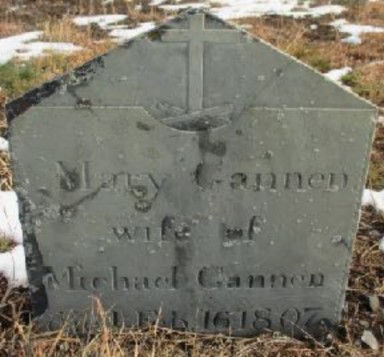
Her marker is an interesting one, in that it is a small slate with a simple Holy Cross and a set of crossed bones (Figure 4, reminiscent of the skulls with crossed bones frequently seen carved on markers from the 1700s, but out of style by the time of her death). The marker was carved by Bartlett Adams, Portland’s first stone-cutter, who arrived in the city in 1800. The design is entirely unique; it’s the only gravestone by Adams that I’ve found featuring a Holy Cross and bones during my extensive surveys of Adams’ work in Maine.
Figure 4.
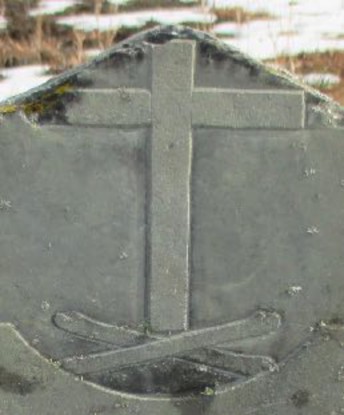
Detail of the Gannen marker showing a simple Holy Cross and pair of bones.
The only other known Bartlett Adams marker featuring a Holy Cross is also located at Eastern Cemetery. It’s for James Davis (Figure 5), who died in 1810 at age 46. While Jordan indicates Mr. Davis’ stone has been lost, I found it very close by the Gannen stone. It’s a slate which features a simple Holy Cross and letters "I. H. S." This is Latin for "Iesus hominum Salvator," or "Jesus, the savior of humankind." In slang, it’s referred to as "In His Service." Under this design, we find a banner with the Latin "Memento Mori" (for "remember death" or "remember we must die.") Bartlett Adams knew Latin and used it on a good number of markers, including three at Eastern Cemetery that he carved for his own infant children.
The Gannen and Davis markers are found in Section L, near the designated ground for African Americans.
Figure 5.
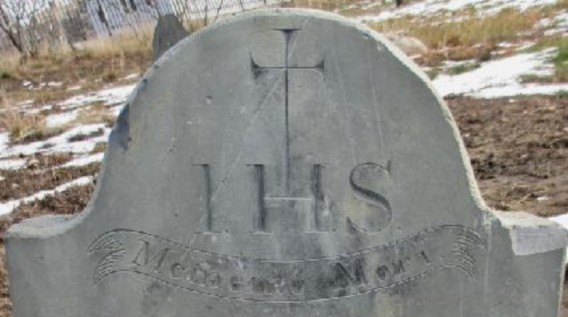
Detail of the Davis marker showing the Latin banner with "Memento Mori."
What About the Others?
Given the age of Eastern Cemetery—over 350 years old—and the many years of neglect, vandalism and natural deterioration of the place, it’s no surprise that so many grave-markers are missing and so many grave plot locations are not known. Only about one-third of the actual graves in the cemetery today are marked with gravestones. This remains true for our list of Catholics. Of the 76 Catholics, 46 have known plot locations and just 27 (about 1/3) have markers on their graves. Thirty Catholics rest in plots without exact known locations.
The next step in this research was to examine the known plot locations for Catholics to see if a pattern could be found. Angela Dexter’s original question was whether or not Catholics had a designated section of the cemetery, similar to those for Quakers and African Americans.
As noted above, the first two Catholic burials were in the far back section of the cemetery (Section L on the map). One more Catholic burial is found in that section, in 1822. Interestingly, this is the grave for Mary Martin, an African American Catholic, who died at age 42. Her stone has been badly damaged and is mostly missing from her plot. Her husband was Francis Martin, whose record notes he was "Black" and "Catholic." His slate grave marker (Figure 6) has survived the ages among a cluster of four Catholic gravestones in Section A of the cemetery. This is the area that Angela Dexter had explored, prompting her original question. These four Catholic graves abut (or are within) the second, newer, African American designated ground of the cemetery.
Francis died 14 years after his wife, in 1836. The fact that he was buried in the new section and not buried by Mary’s side in the old Section L suggests that Section L had completely filled up between 1822 and 1836.
Figure 6.
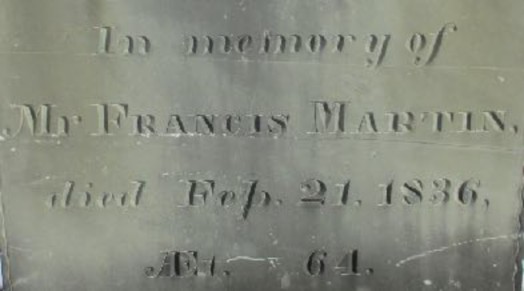
Detail of the slate marker for Francis Martin, one of only six people buried at Eastern Cemetery who is listed as a "Black" and "Catholic." The epitaph carved on his stone reads, in part: "His happy soul has fled; His breathless body shall slumber here among the silent dead."
There are 27 Catholic graves clustered on the borderline between Sections B and C. This represents 60% of the total known Catholic grave locations. Fourteen families are represented there. Seeing those graves plotted on the map (Figure 7) creates a striking image that certainly suggests there was a patch of land designated for the burial of Portland’s Catholics.
Figure 7.
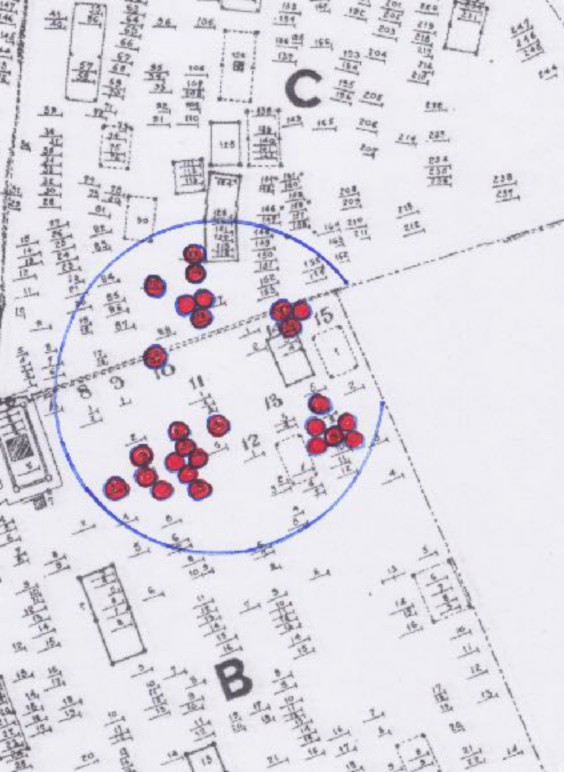
Detail of Eastern Cemetery plot map: With my addition of known Catholic graves. The large numbers are rows, the smaller numbers are graves. [Map FOS 38, from the collections of Maine Historical Society, and used by permission]
Only two other Catholics were buried in Sections B or C, outside of the circled patch shown on the map. They are John and Mary Woods, two young children who died in 1835 at age 3 and 1, respectively. They share a grave marker (Figure 1) which is located in the center of Section B.
I shared my findings about the cluster of Section B Catholic graves with Matt Barker and asked him about the possibility that this was an officially-designated Catholic section. He has not found record of the consecration of any ground at Eastern Cemetery, though it’s well known that consecrated ground was established at the newer Western Cemetery. Catholicism expert Leonard Telesca believes that the individual graves at Eastern Cemetery were most likely blessed by a priest at the time of burial, but that the larger patch of land where they lie would most likely not have been consecrated by the Church since it was city, not Church, property. This makes sense, because we also find burials of people who likely weren't Catholic within the same patch at Eastern Cemetery.
Within the circled area there is a wide range of death dates for Catholics—from 1813 to 1875—with most people being buried in the 1830s decade. Note that there are 35 or more other graves within the same patch occupied by people who have not been identified as Catholic. The date range is similar—1808 to 1875—with the majority of burials occurring in the 1820s decade. Perhaps some of these people actually were Catholic, but their names just don't appear on any list, or perhaps this section simply contains a mix of Catholic and non-Catholic people because of the overall lack of available space in the 1820s and 1830s. I supplied a list of the questionable family names to Matt, but he found none of them to be among the early Catholic families known to him.
Catholic Markers
There are 27 grave markers for Catholics that can be found today at Eastern Cemetery: 20 are made of slate and 7 are made of marble. Three stones are unreadable—the Mary Martin marker discussed above, a slate for Edward Shea (1824) that is broken down to the ground, and a white marble marker for Nicholas Shea (1875) that is heavily eroded. Only a slate foot stone survives on the grave of Henry McAnelley. But the remainder of markers we are able to read. Some stones are for a single person, others memorialize up to four members of a family on one stone.
20 markers are decorated with Catholic symbols. A simple Holy Cross and the letters I.H.S. are most common. Four markers that were obviously cut by the same stone-cutter also feature a heart. The heart can be found on non-Catholic stones as well, and usually signifies "love," but on these Catholic stones, we believe the heart to mean "love of Christ." Two examples of these stones are pictured below (Figures 8 and 9), but notice that one has the heart carved upside-down!
I asked gravestone symbolism expert Laurel Gabel about a possible meaning of the upside- down heart. She has rarely seen such a rendition, perhaps only once before, and to date, the meaning eludes her. Other gravestone enthusiasts suggest "death" or "the heart of the soul." Some wonder if this was simply the carver’s error. Whether this was artistic license of the carver, an error, or an icon with special meaning remains, for now, a bit of a mystery.
Figure 8.
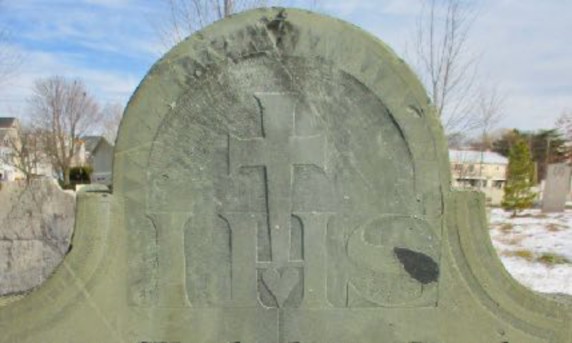
Detail of the 1835 marker for children John and Mary Woods (full stone is pictured, Figure 1). Note the heart, carved upright and similar to 2 other markers at Eastern Cemetery.
Figure 9.
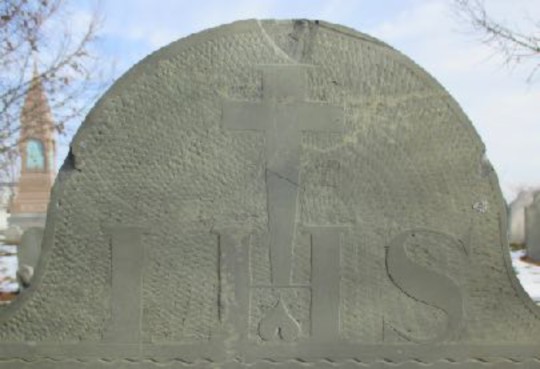
Detail of the 1837 marker for John, Ann, and Dennis Sherredon. Note the heart is upside-down.
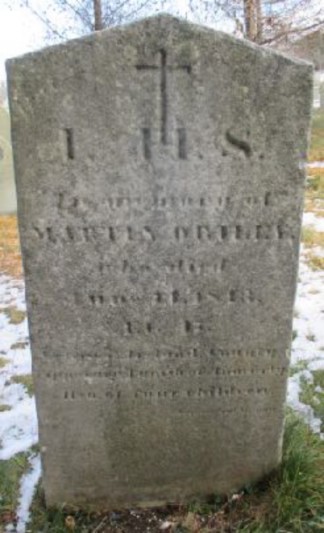
The more typical Catholic markers found at Eastern Cemetery are similar to those seen below for John O’Friell (Figure 10), who died in 1834 at age 15 (in slate), and Martin O’Riley (Figure 11), who died in 1843 at age 47 (in marble, and quite eroded).
Figure 10.
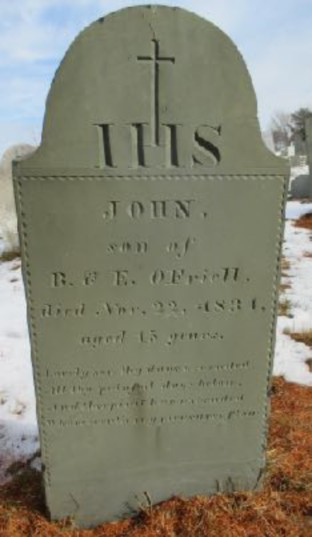
Figure 11.
African American Catholics
Of the 49 records in Jordan, six Catholics are also listed as "Black." One of those is Mary Ann Syms, who died in 1848 at age 47. She is buried in Section A, row 11, grave #18 (Figure 12). Four children named Syms are memorialized on a stone located in the same row at grave #17 (Figure 13). The children died between 1824 and 1839, years that Mary Ann Syms would have been likely to be able to bear children. The children's records are incomplete, since no ages are given, and a check of Portland vital records was of no additional help. Jordan does not list these children as "Black," but I add them to the list of African American Catholics based on my findings (and, admittedly, a hunch).
Figure 12.
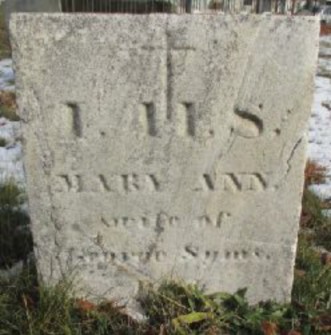
Mary Ann Syms, 1848. Note Catholic decoration on her stone. Her husband George’s final resting place is unknown; he is not on the Eastern Cemetery roster.
Figure 13.
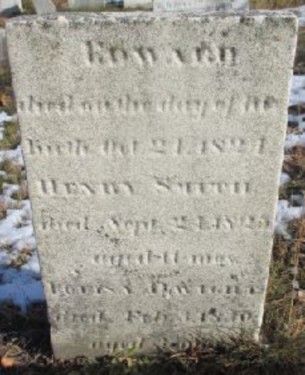
Marble marker for Edward, Henry, Louisa (1) and Louisa (2) Syms, I believe to be four children of Mary Ann Syms. No Catholic decorative elements are found on their stone.
For now, we know of 10 African American Catholics at Eastern Cemetery. The location of the grave for Mary Martin is Section L as noted above. The grave site for Mary Ann Holland (who died 1844) is unknown, although two other Holland graves are next to one another in Section A. One of these burials was in 1837, the other in 1839. It’s quite likely, then, that Mary Ann is buried in Section A as well.
In fact, eight of the 10 Catholics who are African American are buried in Section A, within the area that is designated the second African American section of the cemetery, established in the early 1800s (see map, Figure 2). A notable African American buried there (religion unknown) is Janett Ruby, who died in 1827 at age 22. Next to her is her son William, who died at age 3 in 1828. Janett was married to Rueben Ruby, a successful businessman, one of the founders of the Abyssinian Church, and a leader of Portland’s anti-slavery movement.
Miscellaneous Findings—Longevity, Cause of Death, and a Research Detail
Longevity: A review of records for the 76 Catholics at Eastern Cemetery shows us that almost half died in infancy and childhood. Thirty three died before age 15. Two people lived into their eighties. The breakdown is:
| After Age | Before Age | Total Deaths | Percent |
|---|---|---|---|
| 0 | 1 | 13 | 17% |
| 1 | 10 | 18 | 24% |
| 10 | 20 | 5 | - |
| 20 | 30 | 11 | - |
| 30 | 40 | 5 | - |
| 40 | 50 | 2 | - |
| 50 | 60 | 4 | - |
| 60 | 20 | 3 | - |
| 70 | 80 | 2 | - |
| * | * | 5 | - |
*Unknown
Cause of death: On very rare occasions, the cause of one’s death is noted on the grave marker itself. This is not the case for our Catholics with grave markers. However, a check of Portland vital records and other sources helps to provide some answers to what brought these folks to the end of their lives.
Daniel Sheridan died quite violently on July 21, 1851, at age 19. He was accidentally killed on the Steamer Boston while traveling from Bangor to Boston. Sheridan had fallen into the crank pit of the vessel and was crushed to death. On the other hand, Mary Ward died quite peacefully in 1850 at age 84 of "old age."
Others were taken down by some familiar illnesses of the day, as follows:
| Illness | Number of Deaths |
|---|---|
| Canker | 1 |
| Consumption (tuberculosis) | 6 |
| Croup | 1 |
| Diarrhea | 1 |
| Drowning | 1 |
| Exhaustion | 1 |
| Inflammation of lungs | 1 |
| Palsy | 1 |
| Poisoning | 1 |
| Raising blood/congested lungs | 1 |
| Scarlet Fever | 1 |
| Typhoid Fever | 1 |
Research Detail: I made two particular educated guesses in researching the Catholics of Eastern Cemetery. One was the assumption that the four Syms children were African Americans (as explained above). The second involved another set of four children—those of Martin O’Riley, who died in 1843 at age 47. With his burial record in Jordan, we find this note: "Buried with four children." Yet no other members of the O’Riley family are listed in either of Jordan’s books for Eastern and Western Cemetery, or the MHS file’s roster. So, I began to look into Martin O’Riley’s vital records.
What I found was that Martin O’Riley was born in Tipperary, Ireland, in 1793. His wife Grace O’Brien (1803 to 1874) delivered their first child in Ireland and their second child in New Brunswick, Canada (their emigration route to the USA was through New Brunswick). After they arrived in Portland around 1826, Grace delivered eight more children over an 18-year period.
Since Martin’s records from 1843 indicate he was buried with four children, my research assumption was that four of his ten children had pre-deceased him. Tracing the children went relatively quickly, and the results lined up nicely with this assumption. Six of his children survived beyond his death in 1843. Of the remaining four, only one death record was found—for Michael, who died at age two in 1841. The other three children were born in 1826, 1830, and 1832, but no other vital records were found. The leap of faith was easy—these were the four children noted (but unnamed) in the existing sources. Michael, James, Ann, and Martin O’Riley Jr. now appear on my list of Catholics found at the end of this paper.
Conclusions and Recommendation
In Portland’s earliest days, there were few settlers other than white Protestants from England, and no good records of burials until about 1795, so it’s hard to know whether or not segregation at the time of burial occurred then for anyone who was outside of that particular demographic. But segregation became clearer as the city developed, population increased, and better records were kept. The establishment of a "colored ground" in the old section, another one in the new section after the 1795 expansion, and a "Friends’ ground" for Quakers, suggests that non-white, non-Protestants were buried in sections apart from the majority. So, were there designated Catholic sections?
No formal designation has yet been discovered, and no evidence of consecration of any part of Eastern Cemetery is known. But given that we have found two distinct clusters of graves within the cemetery that hold the remains of 80% of the known Catholics buried there, I do believe that segregation of Catholics occurred at the time of burial.
Recall that at the beginning of the nineteenth century, Irish Catholics (like African Americans) were often treated as second-class citizens. In fact, the burial patterns of the Catholics and African Americans overlap in Section A of the cemetery. It’s my opinion that there is no coincidence to the fact that the two earliest white Catholics buried (Gannen and Davis) were interred in the far back corner of the original ground, just outside (or perhaps within) the first African American designated ground.
Further, note that during the same period of time that the largest cluster (27 Catholics) were buried in Section B, we find the second-largest cluster (8 "Black" Catholics) being buried in Section A. The pattern seems clear—not only were Catholics segregated from Protestants at time of burial, African American Catholics were separated from white Catholics when interred.
Based on these findings, I propose that Spirits Alive (the Friends Group of Eastern Cemetery) update the visitor self-guided tour map (Figure 2), to add designated Catholic sections, to honor the Catholic subterranean residents who have—up until now—been largely forgotten.
Alphabetical List of Known Catholics at Eastern Cemetery
- Multiple people listed on one grave marker are listed based on the plot where the marker is located.
- Spelling of name in column one matches that on the stone (if one exists). Alternate name spellings are provided in the last column.
- Select a heading button in the top row to sort the table on the content in a specific column.
| Archibald, Caroline McGiven | 1881 | 41 | I - 208 | yes | yes | - |
|---|---|---|---|---|---|---|
| Bowers, Catherine | 1843 | 76 | unknown | - | - | - |
| Bowers, Nicholas | 1838 | 0 | C - 115 | yes | yes | - |
| Brown, John | 1838 | 21 | A - 5 - 25 | yes | yes | - |
| Connor, Charles F. | 1855 | 24 | unknown | - | - | - |
| Connor, John | 1843 | 16 | unknown | - | - | - |
| Connor, Richard | 1855 | 22 | unknown | - | - | - |
| Cook, Antonio | 1847 | 68 | K - 10 | yes | yes | - |
| Cook, Lillia | 1858 | 0 | K -11 (a) | no | - | Jordan notes "Buried at side of grandmother K - 11" |
| Cook, Mary J. | 1851 | 72 | K -11 | yes | yes | - |
| Daley, Bridget | 1855 | 0 | unknown | - | - | Bridgett |
| Davis, James | 1810 | 46 | L - 38 | yes | yes | Bartlett Adams carved marker. |
| Devine, Elen | 1835 | 2 | B - 14 - 1 | yes | yes | Elen on marker, Ellen in Jordan |
| Duffy, John | 1838 | 66 | C - 114 | no | - | - |
| Finney, Margaret | 1837 | 75 | B - 10 - 1 | yes | yes | - |
| Gannen, Mary | 1807 | 29 | L - 44 | yes | yes | Gannon in other sources. Bartlett Adams carved marker |
| Guinans, Michael (or Guinn, Michael) | 1841 | 0 | unknown | - | - | MHS file uses Guinn; Jordan uses Guinans |
| Guinn, James | 1846 | 1 | unknown | - | - | - |
| Haggerty, John M. | 1828 | 2 | B - 11 - 4 | yes | no | - |
| Hickey, Dennis | 1841 | 25 | unknown | - | - | Portland Vital Records say he was buried at Western Cemetery, but Jordan has him at Eastern |
| Holland, John | 1837 | 37 | A - 11 - 19 | yes | no | Jordan note: "Black" |
| Holland, Julia Ann | 1839 | 11 | A - 11 - 20 | yes | yes | Jordan note: "Black" |
| Holland, Mary Ann | 1844 | 52 | unknown | - | - | Jordan note: "Black" |
| James, Catherine | 1852 | 0 | unknown | - | - | - |
| Kelly, John | 1848 | 6 | unknown | - | - | Jordan notes "Buried at foot of Mary Barbour’s grave." There are two records for Mary Barbour, both with unknown plot locations. |
| Kelly, Lucy | 1850 | 4 | unknown | - | - | - |
| Kelly, Mary | 1842 | 24 | unknown | - | - | - |
| Landers, Richard | 1842 | 5 | unknown | - | - | - |
| Lynch, Catharine | 1831 | 42 | B - 10 - 6 | yes | yes | - |
| Mahan, John | 1846 | 28 | Tomb A-67 | no | - | Only known Catholic interred in Section A family tombs |
| Mahoney, William | 1853 | 67 | unknown | - | - | - |
| Martin, Francis | 1836 | 64 | A - 10 - 34 | yes | yes | Jordan note: "Black." Wife Mary is far away in Section L |
| Martin, Mary | 1822 | 42 | L - 1 | yes | - | Jordan note: "Black." Stone is broken. |
| Mayland, John | 1804 | 19 | unknown | - | - | Jordan notes "Native of Ireland" |
| McAnelley, Henry | 1839 | 3 | B - 9 - 3 | no | - | Only a footstone is present |
| McAnelley, Margaret | 1838 | 28 | B - 9 - 4 | yes | yes | - |
| McAnelley, Patrick | 1845 | 36 | B - 9 - 4 (a) | no | - | Jordan notes "Buried beside his wife’s grave stone" |
| McCann, Bridget | 1852 | 0 | unknown | - | - | - |
| McCann, Catherine | 1854 | 1 | unknown | - | - | - |
| McCarty, Filene | 1826 | 1 | B - 14 - 6 | no | - | - |
| McCarty, Patrick | 1849 | 87 | unknown | - | - | - |
| McDonnell, Agnes | 1859 | 35 | unknown | - | - | - |
| McGerhan, Rosanna | 1842 | 3 | unknown | - | - | - |
| McGiven, Carrie | 1881 | 35? | unknown | - | - | - |
| Mullin, Bridget Mullin, Susan | 1831 1831 |
0 0 |
B - 14 - 2 | yes | yes | Mullen or Mellen in Jordan |
| Murphy, Margaret | 1853 | 1 | unknown | - | - | - |
| O’Friell, John | 1834 | 15 | C - 89 | yes | yes | - |
| O’Riley, John | 1861 | 32 | unknown | - | - | - |
| O’Riley, Martin | 1843 | 47 | B - 14 - 9 | yes | yes | Jordan notes "Buried with four children." Some members of this family may have been moved to Calvary Cemetery. |
|
O’Riley, Michael O’Riley, James O’Riley, Martin Jr. O’Riley, Ann |
1841 ? ? ? |
2 ? ? ? |
B - 14 - 9 (a) | no | - | Martin O’Riley’s four children unnamed in his record |
| Shea, Edward | 1824 | 4 or 14 | B - 10 - 5 | yes | ? | stone broken |
|
Shea, Eleanor Shea, Nicholas 2nd |
1807 1813 |
0 1 |
B - 10 - 4 B - 10 - 4 |
yes | no | - |
| Shea, Nicholas 1st | 1824 | 48 | B - 10 - 2 | no | - | Barker notes that wife Barbara Connolly Shea died in 1830 and was buried at Eastern. No record is found for her. |
| Shea, Nicholas 3rd | 1875 | 57 | B - 10 - 3 | yes | ? | Stone eroded |
| Sheridan, Daniel | 1851 | 19 | unknown | - | - | Possibly Sherredon |
| Sheridan, Thomas | 1850 | 20 | unknown | - | - | Possibly Sherredon |
|
Sherredon, Ann Sherredon, Dennis Sherredon, John |
1825 1825 1837 |
3 1 42 |
C - 116 | yes | yes | Unusual upside-down heart on marker |
| Sullivan, Daniel | 1886 | ? | unknown | - | - | - |
| Sullivan, John | 1852 | 26 | unknown | - | - | - |
|
Syms, Edward Smith Syms, Henry Smith Syms, Louisa Dwight 1st Syms, Louisa Dwight 2nd |
1824 1825 1830 1839 |
0 0 0 0 |
A - 11 - 17 | yes | no | Jordan note: "Black" |
| Syms, Mary Ann | 1848 | 47 | A - 11 - 18 | yes | yes | Jordan note: "Black" |
| Unknown | 1849 | 35? | unknown | - | - | Jordan notes "Catholic Murdered Man" |
| Ward, Mary | 1850 | 84 | unknown | - | - | - |
| Wiggins, David | 1834 | 22 | B - 8 - 3 | yes | yes | - |
| Woods, John Woods, Mary |
1835 1835 |
3 1 |
B - 8 - 20 | yes | yes | - |
Sources
Description and PDF version: The Catholic Plots.
- Ancestry.com (Vital records, Census records, Immigration files, etc).
- Barker, Matthew Jude, "Maine Irish Heritage Trail - Portland Site Number 41" Blog: Maine Irish Heritage Trail.
- Barker, Matthew Jude, The Irish of Portland, Maine: A History of Forest City Hibernians. Charleston, South Carolina: The History Press, 2014.
- Find-A-Grave.com.
- Gabel, Laurel. Informal interview 2016 (expert on gravestone iconography and symbolism).
- Goold, William, Portland in the Past... B. Thurston & Company, Portland, Maine: 1886.
- Irish Americans Buried in Eastern Cemetery and Western Cemetery, Portland, Maine. Archival Collections #S-6672 at Maine Historical Society, circa 2000.
- Jordan, William B. Jr., Burial Records, 1717–1962 of the Eastern Cemetery, Portland, Maine. Heritage Books, 2009.
- Jordan, William B. Jr., Burial Records, 1811–1980 of the Western Cemetery, Portland, Maine. Heritage Books, 2011.
- Jordan, William B. Jr., Record of Interments with Historical Notes, 1978. Collections of the Maine Historical Society.
- Levinsky, Allan. A Short History of Portland. Applewood Books, 2007.
- Milhomme, Bill, To Be Catholic: St. Mary’s Foxboro: A Case Study 1647–2009. milhomme.blogspot.com. 2009.
- Portland City Guide. Forest City Printing Company, Portland, ME, 1940.
- Telesca, Leonard. Informal interview 2016 (expert in the customs of Catholicism).
- Willis, William. The History of Portland (facsimile edition), New Hampshire Publishing Company, 1972.