Side by Side in the Grave-yard, The Children of Sarah Connell Ayer
Fourteenth in a series of Occasional Papers about Eastern Cemetery in Portland, Maine
by Ron Romano
© June 2026
Figure 0. Ayer Stone at Section K, Plot 3
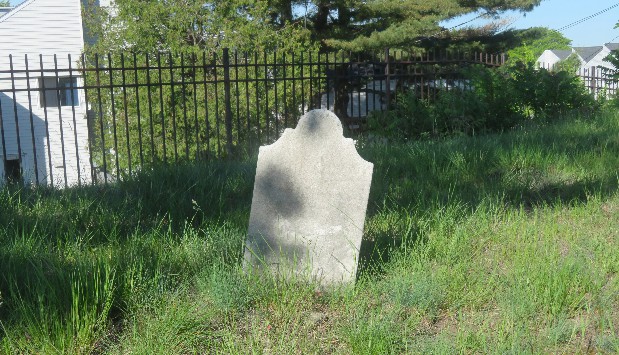
In May 2026, three new burial listings appeared on the Find A Grave website for Eastern Cemetery. There were no photos or biographical details included, and there were no references to any vital records of birth/death, newspaper obits, or published family genealogies that we generally rely on to prove interment. My efforts to confirm these new listings led to the discovery of a remarkable book, the Diary of Sarah Connell Ayer published in Portland in 1910, 75 years after her death. The book not only provides the proof of burial I was seeking, it gives us a rare glimpse of life in Portland—from the perspective of an ordinary woman—during the 11 years she lived in the city: 1811 to 1822.
Contents
- And So It Begins…
- The Babies Ayer
- George Ayer (1814–1815)
- Where’s the Proof?
- Samuel and Sarah Newman (Connell) Ayer
- Highlights from Sarah’s Diary – 1811
- Sarah’s Diary – 1815
- Sarah’s Diary – 1816
- Sarah’s Diary – 1817
- Between September 1817 and March 1821
- Sarah’s Diary 1821 and 1822
- Sarah’s Family of Nine
- References
And So It Begins…
Given the extraordinary amount of scrutiny the records of the “residents” of Eastern Cemetery receive, I’d like to think that by now we have a fairly good idea of who is buried within its seven acres. The Find A Grave website is currently the most accurate source of burials at the cemetery, with nearly 6,500 records. But Find A Grave is a crowd-sourced website, meaning anyone can add listings without approval from a gatekeeper. As the Cemetery Historian for Spirits Alive, I monitor the listings regularly. When people are added to the roster of interred, I check my usual sources to see if I can verify the listing. In many cases, the person is already accounted for. Sometimes a slightly different spelling of name or an inconsistency with a date of death leads to the duplicate listing. Far more often, the person already has a listing at another cemetery; hundreds of bodies were removed from Eastern and reinterred elsewhere in the latter half of the 1800s. When all that fails, I contact the lister of the new record for help. I let them know that Eastern Cemetery is on the National Register of Historic Places and that we therefore work hard to maintain the accuracy of its records. In most cases, we reach agreement regarding editing or removing the listing from the Eastern Cemetery roster.
The Babies Ayer
The three new listings that appeared in May 2026 were:
- Baby Ayer, born December 10, 1811; death date unknown
- Baby Ayer, born October 10, 1812; died October 12, 1812
- Baby Ayer, born September 4, 1813; death date unknown
The three babies were linked to their mother, Sarah (Connell) Ayer (1791–1835), and father, Dr. Samuel Ayer (1786–1832) whose Find A Grave listings include an image of the marble pedestal monument they share at the Old North Cemetery in Concord, New Hampshire. The babies were the first three of this couple’s seven children, and they are also connected on Find A Grave to their four siblings who were born after them. Most notable is their younger brother, George Connell Ayer, who was born November 25, 1814 and died May 24, 1815. Until the three babies were added to Eastern Cemetery’s roster of interred, George was the only member of this family with a record of burial in Portland.
George Ayer (1814–1815)
George is found in Jordan’s published burial records1 as the son of Samuel and Sarah Ayer, who died at the age of 6 months, and with a burial location of Section K, Plot 3. Jordan noted the grave marker as “SBE” which means “stone badly eroded.” It is indeed badly eroded—as seen in the photo (Figure 1)—to the point of being illegible today. When the Spirits Alive transcription project was undertaken in 2010/2011, only the word “In” at the top of the marker (for “In memory of”) was discernible. Knowing his middle name is Connell, a very careful look at the photo seems to reveal the letters “—NNELL” on the top right line. The vital record of George’s death was created long ago and was taken from his (then discernible) gravestone inscription. It contains a minor error in the death date, recorded as May 21 instead of May 24; that minor error carried over into Jordan’s book of burial records. (George’s birth date was actually November 25, off a day from the Vital Record). His marker is white marble and was measured during the transcription project to stand 20 inches tall and 12.5 inches wide. No footstone was noted to be present, although one would have been placed as was common practice at the time of his death.
Figure 1
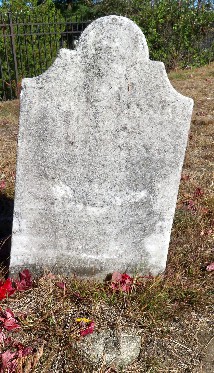
Figure 2: George Ayer’s Vital Record of Birth
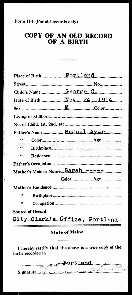
Place of Birth, Portland
Child’s Name, George C.
Date of Birth, Nov. 24, 1814
Sex, M
Father’s Name, Samuel Ayer
Mother’s Maiden Name, Sarah
Source of Record, City Clerk’s Office, Portland
Figure 3: George’s Vital Record of Death (note that the source of the Death VR reads: “From Tombstone”
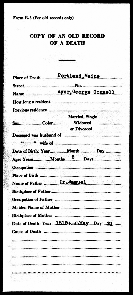
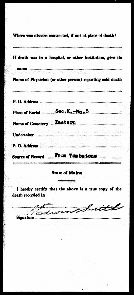
Place of Death, Portland, Maine
Name, Ayer, George Connell
Name of Father, Dr. Samuel
Date of Death, 1815, May 21
Place of Burial, Sec. K - No. 3
Name of Cemetery, Eastern
Source of Record, From Tombstone
His marker is white marble and was measured during the transcription project to stand 20 inches tall and 12.5 inches wide. No footstone was noted to be present, although one would have been placed as was common practice at the time of his death.
Where’s the Proof?
I thought it odd that vital records were available for George but not for the three siblings who were born before him. No newspaper obituaries were found either. Had their births and deaths not occurred in Portland? Tracking down their father’s whereabouts in census or newspaper records from the period might help. No city directory was published until 1823, and Dr. Samuel Ayers was not listed as a resident. The fact that the middle child had both a birth and death date (just 2 days apart) suggested that there was some other documentation somewhere. I reached out to the lister of the babies to let them know that I was unable to find any evidence of their being at Eastern Cemetery in our burial records, vital records, or other sources. I asked what source was used to create the records and suggested it be included in each child’s Find A Grave biography. I did not hear back from the lister and decided that this was a rabbit hole worth diving into. Using the HathiTrust search engine, I plugged in their father’s name—Dr. Samuel Ayer—and quickly got a hit.
In 1910, the Lefavor-Tower Publishing Company in Portland published the Diary of Sarah Connell Ayer (Figure 6). Three subtitles follow the title, the first two reflecting her time in Massachusetts and New Hampshire; the last reading “Portland and Eastport Maine” which is the material of interest here. The diary covers Sarah’s life from age 14 (in 1805) to her death in 1835 at age 44.
On page 209, I found this entry from September 29, 1815. The page was entitled “Volume III” and she wrote that her husband had purchased a new journal for her to again commence making her reflections on passing events. She admitted to having had a long pause in keeping her diary, noting “The last volume of my journal was ended 26th of Oct. 1811. Since then, frequent illness, and many other circumstances have prevented me from continuing it. But as I now have a small family, and nothing to interrupt me, I intend beginning anew, thinking it will be a pleasant, and perhaps not unprofitable way of spending my leisure moments.…”
We can read between the lines a bit here. Her reference to having a “small family” was confirmation that only she and her husband Samuel were included; no children were alive when she began this new volume of her diary. Additionally, I view her comment that she now had “nothing to interrupt me” as an indirect reference to the fact that no children were living to occupy her time. But there’s no need to read between the lines that followed—Sarah gave us exactly the proof that I wanted to confirm that her babies were interred at Eastern Cemetery:
Figure 4
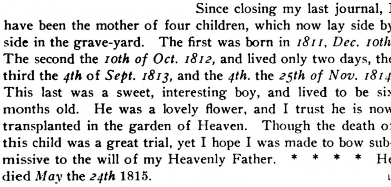
- Since closing my last journal, I have been the mother of four children, which now lay side by side in the grave-yard. The first was born in 1811, Dec. 10th. The second the 10th of Oct. 1812, and lived only 2 days, the third the 4th of Sept. 1813, and the 4th the 25th of Nov. 1814. This last was a sweet, interesting boy, and lived to be 6 months old. He was a lovely flower, and I trust he is now transplanted in the garden of Heaven. Though the death of this child was a great trial, yet I hope I was made to bow submissive to the will of my Heavenly Father. He died May the 24th 1815.
While Sarah wrote the birth dates of her first four children, she gave death dates for only two. This suggests that the other two were stillborn; otherwise we’d expect her to have recorded the number of days they lived as she did for the second baby. Additionally, none of the first three were named, providing further proof that they just did not survive much beyond birth. There’s one more indicator of stillbirth—only George was given a grave marker at the cemetery. He’d lived a very short life, but long enough for his parents to get to know him as a person and, ultimately, worthy of having his own stone to mark his grave.
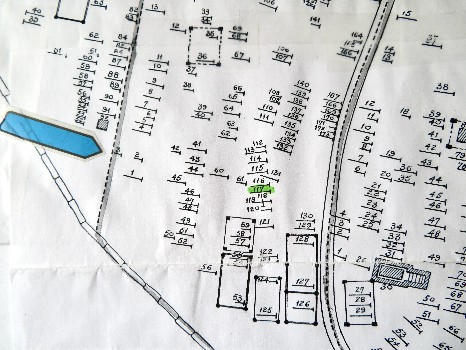
So the new listings for three babies are legitimate! Though no stones are found for them, we can confirm their burial locations, as Sarah wrote that the four (including George) were “side by side in the grave-yard.” George’s grave marker is at Plot 3 in Section K. A look at the plot map shows plenty of adjacent space for his three infant siblings.
Figure 5: Detail of Eastern Cemetery’s plot map showing a portion of Section K. The arrow points to George Ayer’s gravestone at Plot #3. Unmarked plots to either side of his grave hold the remains of his three siblings
Samuel and Sarah Newman (Connell) Ayer
The parents of the four laying side by side were Dr. Samuel Ayer and Sarah Newman (Connell) Ayer. Samuel was born in Concord, New Hampshire, in 1786. He attended Dartmouth College, receiving a Bachelor of Medicine degree in August of 1810. Two months later, he and Sarah married. She was born in Philadelphia in 1791, the only child of Captain George Connell and Mary Greenleaf. Samuel and Sarah briefly lived in Philadelphia while Samuel continued his studies. In February of 1811, he was admitted as an honorary member to the Philadelphia Medical Society following the delivery of his paper on digestion. From there, they went to New Hampshire.
Highlights from Sarah’s Diary – 1811
Sarah Ayer was deeply religious. Her diary is full of references to God, prayer, hymns, her attendance at church services and lectures, and meeting with friends to talk about religious subjects. When her diary was transcribed for printing, the publisher omitted dozens of pages that consisted of notable sermons she had painstakingly written within. One other note about her diary: Sarah always referred to her husband as “Mr. Ayer” not “Dr. Ayer” or even “Samuel.” She sometimes wrote “my husband” but far more often just used the formal “Mr. Ayer.”
Figure 6
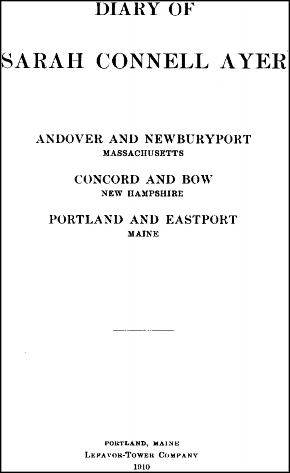
- Diary of Sarah Connell Ayer: Andover and Newburyport, Massachusetts; Concord and Bow, New Hampshire; Portland and Eastport, Maine. Portland, Maine: Lafavor-Tower Company, 1910.
Sarah’s diary entry of June 23, 1811, sets the stage for their 11 years in Portland. She was pregnant with her first child then. She wrote “everything being ready we concluded to set off for Portland this week.” Soon after arriving in Portland, Sarah wrote on July 8 “today we have taken lodgings at Capt. McLellan’s and shall continue here till we hear of a convenient house…” Who this was isn’t clear; there are seven men named Captain McLellan buried at Eastern Cemetery who were alive in 1811.
Though I couldn’t find any explicit statements regarding her pregnancy of 1811, there are a few hints to her condition in her journal entries through the summer. She noted occasionally not feeling well or being “excessively tired,” but she would go for walks with neighbors, noting on at least three occasions that walking would “do me good,” and that she thought “walking conducive to my health.” They moved out of the McLellan house in September.
- September 27th’s entry: “In the morning Capt. Moody2 arrived…with our furniture.”
- September 28: “I went down to the house to assist in making preparations for our removal there.” And this, “Our little family consists of Mr. Ayer and myself, Aunt Newman, Mary Greenleaf, and Woodbury Hatch, a boy of about 13 years old that we have taken in to live with us. I felt a kind of pensive pleasure, in looking round on the little circle, and felt an ardent desire to make my family happy, and our dwelling the seat of domestic peace, virtue and religion. I felt indeed that my duties were increased, and that if I expected to discharge them [correctly] I must use diligence, watchfulness, and prayer.”
On October 26, 1811, her journal writings came to a temporary end with this final line: “The day has been cold, and uncomfortable, and reminded us of the fast approach of winter.” Six weeks later, she would deliver “Baby 1,” the first of six children born in Portland.
Once she commenced her journal-writing in September of 1815, she documented her life in Portland fairly consistently through 1817. Then there was another pause of about 4 years until 1821. In the fall of 1822, Samuel was appointed the Surveyor of the port of Passamaquoddy, necessitating their move to Eastport. Her diary continued there.
What follows are some of the more interesting passages found during Sarah’s Portland years, reflecting her family, her faith, and local events.
Sarah’s Diary – 1815
September 28: This entry is remarkable. It not only gave proof of burial for her first four children, it provided some details regarding Lieutenant Kervin Waters, who fought in the storied battle between the HMS Boxer and the USS Enterprise, 2 years earlier. Waters died September 15, 1815, and was laid to rest next to his captain, William Burrows, and the British captain, Samuel Blyth, both of whom died the day of the battle in 1813. In this passage, we learn that Sarah’s husband (again referred to here as “Mr. Ayers”) attended to Waters during his 2 years of ailing.
Figure 7
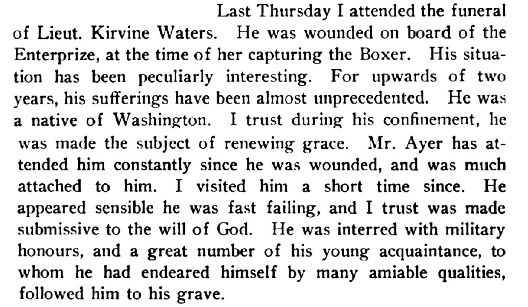
- Last Thursday I attended the funeral of Lieut. Kirvine Waters. He was wounded on board of the Enterprize, at the time of her capturing the Boxer. His situation has been peculiarly interesting. For upwards of 2 years, his sufferings have been almost unprecedented. He was a native of Washington. I trust during his confinement, he was made the subject of renewing grace. Mr. Ayer has attended him constantly since he was wounded, and was much attached to him. I visited him a short time since. He appeared sensible he was fast failing, and I trust was made submissive to the will of God. He was interred with military honours, and a great number of his young acquaintance, to whom he had endeared himself by many amiable qualities, followed him to his grave.
Sarah’s Diary – 1816
- January 2: Sarah wrote that she went to visit a friend and found some company already there. “This visit was not profitable to myself, or others. All religious conversation was excluded [and] cards, one of the things which are an abomination to me, were introduced in the evening. I left the company early…” Sarah much preferred visiting with those who talked religion rather than playing games!
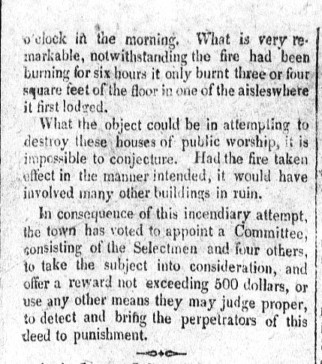
- June 15: Sarah wrote “Last night an attempt was made to destroy our meeting-house by fire. It was burning from 11 till 5 in the morning, still but little injury was done, when it was discovered.”
The Portland Gazette newspaper published June 18, 1816, covered the story of the arson.
Figure 8
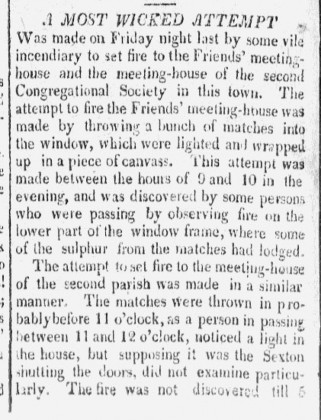
Figure 8a
A MOST WICKED ATTEMPT
Was made on Friday night last by some vile incendiary to set fire to the Friends’ meeting house and the meeting-house of the second Congregational Society in this town. The attempt to fire the Friends’ meeting-house was made by throwing a bunch of matches into the window, which were lighted and wrapped up in a piece of canvas. This attempt was made between the hours of 9 and 10 in the evening, and was discovered by some persons who were passing by observing fire on the lower part of the window frame, where some of the sulphur from the matches had lodged.
The attempt to set fire to the meeting-house of the second parish was made in a similar manner. The matches were thrown in probably before 11 o’clock, as a person in passing between 11 and 12 o’clock, noticed a light in the house, but supposing it was the Sexton shutting the doors, did not examine particularly. The fire was not diagnosed till 5 o’clock in the morning. What is very remarkable, notwithstanding the fire had been burning for six hours it only burnt three or four square feet of the floor in one of the aisles where it first lodged.
What the object could be in attempting to destroy these houses of public worship, it is impossible to conjecture. Had the fire taken effect in the manner intended, it would have involved many other buildings in ruin.
In consequence of this incendiary attempt, the town has voted to appoint a Committee, consisting of the Selectmen and four others, to take the subject into consideration, and offer a reward not exceeding 500 dollars, or use any other means they may judge proper, to detect and bring the perpetrators of this deed to punishment.
- July 30: Sarah recounted a recent visit to Newburyport Massachusetts with her aunt. This passage is a reminder today of how challenging travel was in the early 1800s. A trip to Newburyport today is an easy seventy-five minute drive from Portland, but for Sarah and her aunt it was anything but easy. They’d left Portland on Capt. Moody’s packet ship in the morning. “We had a tedious and unpleasant passage, 13 passengers, all sea-sick, but myself.” The wind was initially favorable, but a gale wind forced them to shelter in Portsmouth Harbor, where she and her aunt "went on shore at Great Island and spent the night; found very good accommodations.” The weather did not cooperate for their return journey either, as Sarah noted “we were detained by east winds a week longer in Newbury Port than we intended to stay.”
- December 1: Sarah wrote that she had missed a church meeting “being much fatigued with watching3 last night with Aunt Greenleaf” who had “suffered much through the night.”
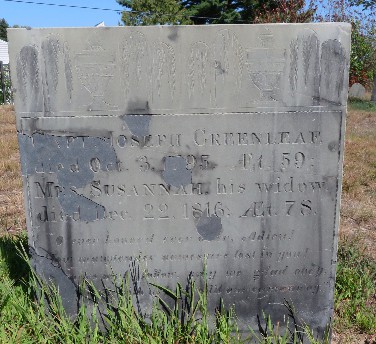
- December 22: “This morning Aunt Greenleaf died.” This was Susannah (Pearson) Greenleaf, the widow of Capt. Joseph Greenleaf, who had predeceased her by 20 years. The Captain’s fame was for his role as the first keeper of the Lighthouse at Portland Head, a position to which he was appointed by President George Washington. Susannah and Joseph have a shared slate gravestone at their gravesites in Section K, plot 45, just two rows away from the four Ayer children laying side-by-side.
Figure 9. Shared marker for Sarah’s aunt Susannah Greenleaf, who died at age 78 in 1822, and her husband Captain Joseph Greenleaf, first keeper of the Portland Head Light. The slate is spalling and is in further danger of deterioration. It is just steps away from the graves of Sarah’s four infant children.
Sarah’s Diary – 1817
- April 10: Sarah received a letter from her father informing her that her mother was quite ill and that “it was necessary for me to come on directly, if I wished to see her before she died. Mr. Ayer consented to my going, and I concluded to go as far as Newburyport with Capt. Moody, it being less fatiguing than traveling in the stage.”
Despite Sarah’s decision to take the less fatiguing option, this trip would prove as challenging as the one taken in 1816. - April 12: “At 6 in the morning we went on board Capt. Moody’s sloop. We had a fair wind for an hour, or two, after that a head wind during the day, so that at night we were obliged to put in to winter-harbor. Most of the passengers went ashore, and we found very good accommodations.” The following day the winds were still unfavorable, but Capt. Moody called the passengers to board that evening for sailing overnight.
- April 14: The journey continued, as recorded in Sarah’s diary Monday, April 14 (Figure 10).
Figure 10
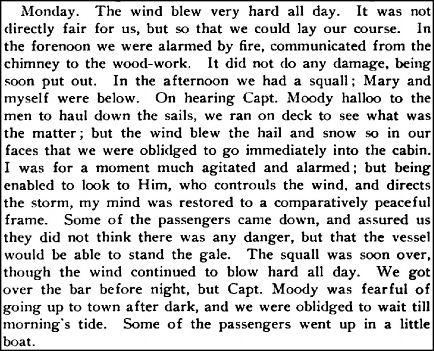
- Monday. The wind blew very hard all day. It was not directly fair for us, but so that we could lay our course. In the forenoon we were alarmed by fire, communicated from the chimney to the wood-work. It did not do any damage, being soon put out. In the afternoon we had a squall; Mary and myself were below. On hearing Capt. Moody halloo to the men to haul down the sails, we ran on deck to see what was the matter; but the wind blew the hail and snow so in our faces that we were obliged to go immediately into the cabin. I was for a moment much agitated and alarmed; but being enabled to look to Him, who controls the wind, and directs the storm, my mind was restored to a comparatively peaceful frame. Some of the passengers came down, and assured us they did not think there was any danger, but that the vessel would be able to stand the gale. The squall was soon over, though the wind continued to blow hard all day. We got over the bar before night, but Capt. Moody was fearful of going up to town after dark, and we were obliged to wait till morning’s tide. Some of the passengers went up in a little boat.
- April 15: So after 3 days of travel, Sarah was on dry land at last. However, she still had two stagecoach rides to get her to Bow, New Hampshire, to see her parents.
- April 16: Sarah spent a full day traveling by coach from Newburyport to Bradford, then Haverhill, Massachusetts. There she boarded another stage to New Hampshire and—after being taken across the Merrimack River—finally reached her parents’ farm in Bow. For the next two weeks, Sarah attended to her dying mother there.
- May 1: Mrs. Connell died
- May 3: Sarah wrote that her mother’s funeral was well attended by friends and acquaintances, and that she was interred “in the village grave-yard.” Mrs. Connell’s undecorated gravestone is found today in Bow Junction, NH, in the Alexander Cemetery (formerly called the East Cemetery, but more familiarly the village cemetery).
Samuel had travelled more directly to Bow from Portland to join Sarah for the funeral and burial services. Over the next few days they were able to convince Sarah’s father to move to Portland for a while with them.
Figure 11
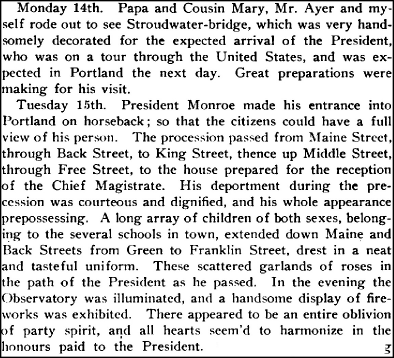
Monday 14th. Papa and Cousin Mary, Mr. Ayer and myself rode out to see Stroudwater-bridge, which was very handsomely decorated for the expected arrival of the President, who was on a tour through the United States, and was expected in Portland the next day. Great preparations were making for this visit.
Tuesday 15th. President Monroe made his entrance into Portland on horseback; so that the citizens could have a full view of his person. The procession passed from Maine Street, through Back Street, to King Street, thence up Middle Street, through Free Street, to the house prepared for the reception of the Chief Magistrate. His deportment during the procession was courteous and dignified, and his whole appearance prepossessing. A long array of children of both sexes, belonging to the several schools in town, extended down Maine and Back Streets from Green to Franklin Street, drest in a neat and tasteful uniform. These scattered garlands of roses in the path of the President as he passed. In the evening the Observatory was illuminated, and a handsome display of fireworks was exhibited. There appeared to be an entire oblivion of party spirit, and all hearts seemed to harmonize in the honours paid to the President.
- May 9: Sarah’s journey back to Maine was equally as arduous as her trip to New Hampshire. As they were leaving Dover, New Hampshire in their coach, the horse stumbled on a hill, fell, and landed on the coach, breaking the driver’s chaise. Sarah wrote “I was able to get out without sustaining any injury, though considerably frightened.” Three neighbors heard the commotion and came to assist. Soon enough, the coach was once again on its way.
- July 14 & 15: President James Monroe, 5th US President, visited Portland that summer and Sarah recorded her impressions in her diary (Figure 10).
- August 5: One single line was recorded — Mrs. Payson spent the night with me."
The next entry explains this further… - August 31: “Since I last wrote in my journal, I have been made the happy Mother of a promising little girl.” She was born August 6, and surely was the reason for Mrs. Payson spending the night of the 5th with Sarah. She named her daughter after herself: Sarah Connell Ayer. Thankfully, this child would survive.
- September 28: “My little Sarah Connell was baptized by Mr. Cogswell of Saco…” This was the final entry in Sarah’s diary until 1821.
Between September 1817 and March 1821
Perhaps Sarah imagined that years into the future someone might want to know the reasons for taking a break in writing her journal. She wrote:
Figure 12
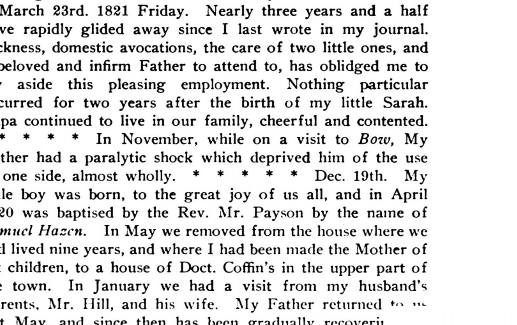
March 23rd. 1821 Friday. Nearly 3 years and a half have rapidly glided away since I last wrote in my journal. Sickness, domestic avocations, the care of two little ones, and a beloved and infirm Father to attend to, has obliged me to lay aside this pleasing employment. Nothing particular occurred for 2 years after the birth of my little Sarah. Papa continued to live in our family, cheerful and contented.
In November, while on a visit to Bow, My Father had a paralytic shock which deprived him of the use of one side, almost wholly.
December 19th. My little boy was born, to the great joy of us all, and in April 1820 was baptized by the Rev. Mr. Payson by the name of Samuel Hazen. In May we removed from the house where we had lived 9 years, and where I had been made the Mother of six children, to a house of Doct. Coffin’s in the upper part of the town. In January we had a visit from my husband’s Parents, Mr. Hill, and his wife. My Father returned to us last May, and since then has been gradually recovering…
Sarah’s Diary 1821 and 1822
The remaining entries from 1821 were largely her recordings of her attendance at prayer meetings, missionary meetings, religious lectures, and Sabbath services. She wrote about visits to and from friends, but wrote nothing of the joys of motherhood. In 1821 her daughter Sarah turned four and her son Samuel turned two. Sarah often covered the topics of the ailments of her family. On August 3, 1821, she noted “…ill health has interrupted my journal. I thought myself drawing near to the grave.”
June 15, 1822: “In the afternoon we were alarmed by the cry of ‘fire.’ It was in Green Street, and being a very dry time, and the wind high; so it was greatly feared all the upper part of the town would be destroyed… I hastened to the spot, and assisted in clearing houses, and conveying goods from the scene of destruction. The fire seemed to spread from house to house, till the whole on one side [of the street] were enveloped in flames. It spread with wonderful rapidity, but was providentially stopped before it crossed the street… Many were driven from their homes, to seek shelter among friends.”
Sarah did not write that she was part of the 100-strong women’s bucket brigade that quickly formed at the scene. This was well-covered by the two local newspapers. Each story is worth reading in its entirety for the unique details reported. They are included as the Appendix to this document. Another fire was reported on June 16 at the swamp near the Brackett Farm in Portland. Dry conditions and high winds once again led to fears that nearby homes might catch fire. Thankfully, rain came the next day.
June 21: "Mr. Ayer, having received the appointment of Surveyor of the port of Eastport, left me today, to go down… to enter upon the duties of the office, which commence the first of July. I have anticipated this removal for a long time. I shall leave Portland with regret. Here I have spent the first 10 years of my married life, ’tis the birth-place of my children, four of which lie in the grave-yard, a spot to which I love to resort…” Sarah’s time was drawing to a close in Portland. Samuel stayed in Eastport until July 19. On that day Sarah wrote that he was pleased with Eastport and told her that she would find many religious friends there.
September 22: “I am at last quietly settled at Eastport.”
Sarah continued her diary in Eastport, where she, Samuel and their children would live for 11 years. On March 15, 1823 she wrote “I became the mother of another little girl. For three weeks before the birth of my infant I was very dangerously ill, so that my friends did not expect my life. I had watchers every night, and did not myself expect ever to recover. My life, and the life of my child was spared…” Sarah named this daughter Harriet Osgood after a childhood friend.
Sarah’s Family of Nine
Here are vital details of Sarah’s family, beginning with her children in chronological order of birth. With none of her children having kids of their own, this family tree came to an end.
| Baby 1 | 10 December 1811 | same day likely | less than 1 day | Eastern Cemetery, Portland | - |
|---|---|---|---|---|---|
| Baby 2 | 10 October 1812 | 12 October 1812 | 2 days | Eastern Cemetery, Portland | - |
| Baby 3 | 4 September 1813 | same day likely | less than 1 day | Eastern Cemetery, Portland | - |
| George Connell Ayer | 25 November 1814 | 24 May 1815 | 6 months | Eastern Cemetery, Portland | - |
| Sarah Connell Ayer | 6 August 1817 | 24 November 1881 | 64 years | Congressional Cemetery, Washington, DC | Note 1 |
| Samuel Hazen Ayer | 19 December 1819 | 4 October 1853 | 33 years | Old North Cemetery, Concord, NH | Note 2 |
| Harriet Osgood Ayer | 15 March 1823 | 2 May 1835 | 12 years | Old North Cemetery, Concord, NH | Note 3 |
| Dr. Samuel Ayer | 31 August 1786 | 11 November 1832 | 46 years | Old North Cemetery, Concord, NH | Note 4 |
| Sarah Newman (Connell) Ayer | 17 June 1791 | 7 May 1835 | 44 years | Old North Cemetery, Concord, NH | Note 5 |
- Note 1 – (daughter) Sarah Connell Ayer: Although she was one of only two children who reached adulthood, she never married. She was 15 when her father died and 18 when her mother died. In the appendix of the published diary, it is noted that “After her mother’s death she lived with various members of her father’s family.” [recall that her mother was an only child]. Further, “She was a teacher, but nearly all her work was done in the South. She is said to have been very peculiar, and in many ways a trial to her relations…”
- Note 2 – (son) Samuel Hazen Ayer: Samuel was 13 when his father died and 16 when his mother died. Still a minor, he had become a ward of the Honorable Isaac Hill. He attended Bowdoin College, graduating in 1839. He was admitted to the NH Bar and practiced law in Hillsborough, New Hampshire. He was a town representative for 5 years and Speaker of the House for 2 years. He also never married, and died suddenly in 1853.
- Note 3 – (daughter) Harriet Osgood Ayer: Youngest of seven, and 9 years old when her father died, she succumbed to scarlet fever when she was 12. The newspaper accounting of her death noted that “she was a child of remarkable intellect, mild in her disposition, affectionate, sensible, and so promising as to have attracted more than ordinary attention.” She would have been comforted by her mother Sarah in her final days, but Sarah quickly followed her to the grave, also taken by scarlet fever just 5 days after Harriet died.
- Note 4 – (husband) Dr. Samuel Ayer: Sarah’s diary entries in the last 2 years of Samuel’s life are filled with notes of his health. He would be very ill, then recover, and back to being unwell. She expressed worry over his condition on many occasions. Her longest journal entry came on November 25, 1832, where she provided extensive writings about Samuel’s final days of illness, his death, and aftermath of his passing. These pages—full of sorrow—pull at the heart strings. She knew that she would not be able to keep their house. She and the children would have to rely on Samuel’s connections for shelter thereafter.
- Note 5 – Sarah: Sarah died five days after losing 12-year-old Harriet. She left behind her two surviving teenagers Sarah and Samuel. In her newspaper obituary she was remembered as “Caressed by fond parents and friends in early life, she lived to drink deep of life’s bitter cup in the privation of parents and husband, and nearly every blood connection saving two remaining children. Her last 2 years were spent with friends and connections of her deceased husband upon whose arms she threw herself and her orphan children. She was a lady of excellent education, a zealous but humble follower of the meek and lowly Savior, on whose name her last faltering accents whispered praise.”
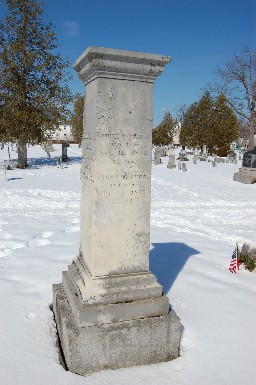
Figure 13: Sarah and Samuel’s grave marker in Concord NH. Courtesy of Ann LaCombe
THE END
Appendix
Portland Gazette, June 18, 1822
Figure A1
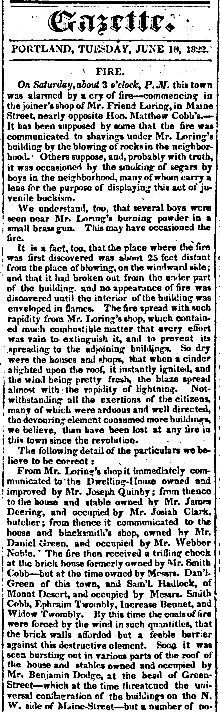
Figure A2
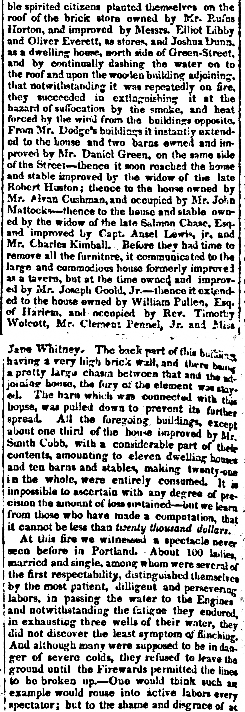
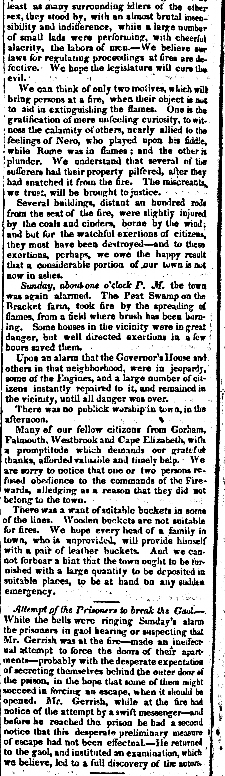
Figure A3
EASTERN ARGUS, Portland, Tuesday, June 18, 1822
FIRE
It has become our painful duty to record one of the most extensive ravages by fire, which Portland has experienced since the town was laid in ashes during the Revolutionary War. On Saturday last, between three and four o'clock in the afternoon, a joiner’s shop on Main street, a few doors to the westward of Green street, was discovered to be on fire. People were at work on the street near this shop, blowing rocks, and it is supposed that some of the fire, which they kept for that purpose, was carried by the wind under the shop. The building contained a considerable quantity of shavings and other combustible materials; and when the fire was discovered, it had made too great progress to be resisted. An alarm was made, the bells were rung, and the citizens promptly and in great numbers thronged to the theatre of devastation. Anxiety was at once raised to its highest pitch, and even boldness and fortitude began to tremble; for the long and excessive drought had in a great measure dried up the fountains; the pools had become parched ground; the earth under our feet was powder and dust; the moisture had been driven from every combustible substance; and never did flames appear to rush with greater rapidity, or devour with more eagerness. There were a large number of wooden buildings in the immediate vicinity of the fire, a brisk wind from the westward driving the enraged element directly into the town, and but little water to be obtained, except by going a long distance. By the time the engines could begin to play, two or three small buildings were enveloped in flames, and the only hope of saving a large portion of the town, seemed to rest on the possibility of preventing the fire from crossing Green street. The course of the fire down the westerly side of Green street, was perfectly resistless, and so rapid as to drive people from their houses before their furniture could all be removed. Some buildings were torn away, in order to arrest its progress, but it was all in vain, for it still raged on. In the mean time every possible exertion was made to prevent the furious enemy from crossing the street; and although there was, much of the time, a manifest want of regularity and system in the movements of the people, their efforts were successful beyond what the boldest heart had dared to expect. The easterly side of the street was principally lined with wooden buildings, and in the vicinity were stables, barns, work-shops, bake-houses surrounded with faggots, soap-houses filled with tallow, and every thing was in perfect readiness, like a tinder-box, to burst into a blaze from every falling spark. The winds were sporting with glowing embers, scattering them in showers to the distance of half a mile, and young fires were starting up, like hydras, in every yard and on every building. Nothing short of the utmost vigilance, promptitude and energy, could withstand a foe, that charged at so many points, and was re-enforced so often. The contest was a long time doubtful, and the blended pictures of hope and despair held a rival sway over many a countenance. Had the fire obtained a firm hold on the easterly side of the street, one half of the town must probably have fallen before it. This consideration inspired every heart with resolution, and nerved every arm with vigor. What man could do was done. The engines were kept in constant play upon the buildings most exposed; and finally, a little before sunset, the fire, having spent its rage upon everything within its reach on the westerly side of the street, at last submitted to put off the master and become again the servant of man.
There were upwards of twenty buildings destroyed, fourteen or fifteen of which were dwelling houses. The amount of property lost, we should think might be estimated somewhere between twenty and thirty thousand dollars. Messrs. Benjamin Dodge, Daniel Green, and Joseph Gould, are among those, who sustain the heaviest losses. There are others probably, who had less to lose, and yet have a fall cup of affliction, for they have lost all. By this misfortune twenty families have been turned into the streets, destitute of house and home. Humanity pleads their cause, and we trust their cause will not be plead in vain. A generous and sympathizing public will not say to the naked, be ye clothed, and to the hungry, be ye fed; they will stretch forth their hands to the needy, and minister comforts to those in distress. A person never learns the true value of riches till he has the opportunity and the disposition to bestow something in charity. It is then that he tastes the sweetest morsel, that wealth can procure—it is then that he plucks a rose, that will not fade in bis hand—it is then that he finds a gem, which will glow with everlasting brightness—and it is then that he becomes possessed of a recollection, which will not pall upon his feelings, like the memory of riches squandered away for idle and useless purposes.
Several accidents occurred by falling of ladders, and some persons, we understand were considerably injured, but none dangerously, During the fire, reports were circulated through town, in a number of instances, that persons were killed. If people would be more cautious on such occasions, not to spread false rumors, they might save much needless anxiety and distress.
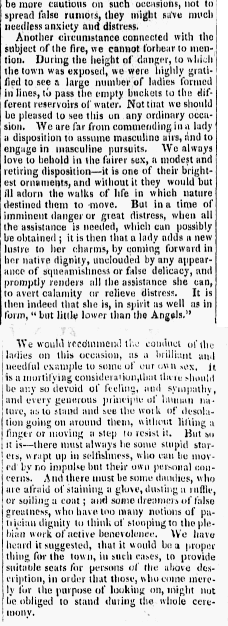
Another circumstance connected with the subject of the fire, we cannot forbear to mention. During the height of danger, to which the town was exposed, we were highly gratified to see a large number of ladies formed in lines, to pass the empty buckets to the different reservoirs of water. Not that we should be pleased to see this on any ordinary occasion. We are far from commending in a lady a disposition to assume masculine airs, and to engage in masculine pursuits. We always love to behold in the fairer sex, a modest and retiring disposition—it is one of their brightest ornaments, and without it they would but ill adorn the walks of life in which nature destined them to move. But in a time of imminent danger or great distress, when all the assistance is needed, which can possibly be obtained; it is then that a lady adds a new luster to her charms, by coming forward in her native dignity, unclouded by any appearance of squeamishness or false delicacy, and promptly renders all the assistance she can, to avert calamity or relieve distress. It is then indeed that she is, in spirit as well as in form, "but little lower than the Angels."
We would recommend the conduct of the ladies on this occasion, as a brilliant and needful example to some of our own sex. It is a mortifying consideration, that there should be any so devoid of feeling, and sympathy, and every generous principle of human nature, as to stand and see the work of desolation going on around them, without lifting a finger or moving a step to resist it. But so it is—there must always he some stupid starers, wrapped up in selfishness, who can be moved by no impulse but their own personal concerns. And there must be some dandies, who are afraid of staining a glove, dusting a ruffle, or soiling a coat; and some dreamers of false greatness, who have too many notions of patrician dignity to thin of stooping to the plebeian work of active benevolence. We have heard it suggested, that it would be a proper thing for the town, in such cases, to provide suitable seats for persons of the above description, in order that those, who come merely for the purpose of looking on, might not be obliged to stand during the whole ceremony.
Eastern Argus, June 18, 1822
Figure B1
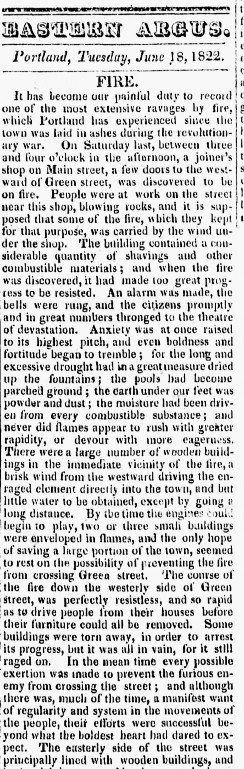
Figure B2
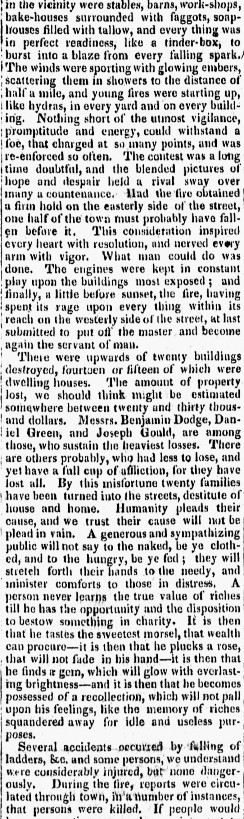
Figure B3
GAZETTE, Portland, Tuesday, June 18, 1822
FIRE
On Saturday, about 3 o'clock, P.M. this town was alarmed by a cry of fire—commencing in the joiner's shop of Mr. Friend Loring, in Maine Street, nearly opposite Hon. Matthew Cobb’s. It has been supposed by some that the fire was communicated to shavings under Mr. Loring's building by the blowing of rocks in the neighborhood. Others suppose, and, probably with truth, it was occasioned by the smoking of segars by boys in the neighborhood, many of whom carry a lens for the purpose of displaying this act of juvenile buckism.
We understand, too, that several boys were seen near Mr. Loring's burning powder in a small brass gun. This may have occasioned the fire.
It is a fact, too, that the place where the fire was first discovered was about 25 feet distant from the place of blowing, on the windward side; and that it had broken out from the under part of the building. and no appearance of fire was discovered until the interior of the building was enveloped in flames. The fire spread with such rapidity from Mr. Loring's shop, which contained much combustible matter that every effort was vain to extinguish it, and to prevent its spreading to the adjoining buildings. So dry were the houses and shops, that when a cinder alighted upon the roof, it instantly ignited, and the wind being pretty fresh, the blaze spread almost with the rapidity of lightning. Notwithstanding all the exertions of the citizens, many of which were arduous and well directed, the devouring element consumed more buildings, we believe, than have been lost at any fire in this town since the revolution.
The following detail of the particulars me believe to be correct: From Mr. Loring's shop it immediately communicated to the Dwelling-House owned and improved by Mr. Joseph Quinby; from thence to the house and stable owned by Mr. James Deering, and occupied by Mr. Josiah Clark, butcher; from thence it communicated to the house and blacksmith's shop, owned by Mr. Daniel Green, and occupied by Mr. Webber Noble." The fire then received a trifling check at the brick house formerly owned by Mr. Smith Cobb—but at the time owned by Messrs. Dan'l. Green of this town, and Sam'l Hadlock, of Mount Desert, and occupied by Messrs. Smith Cobb, Ephraim Twombly, Increase Bennet, and Widow Twombly. By this time the coals of fire were forced by the wind in such quantities, that the brick walls afforded but a feeble barrier against this destructive element. Soon it was seen bursting out in various parts of the roof of the house and stables owned and occupied by Mr. Benjamin Dodge, at the head of Green Street—which at the time threatened the universal conflagration of the buildings on the M.W. side of Maine Street—but a number of noble spirited citizens planted themselves on the roof of the brick store owned by Mr. Rufus Horton, and improved by Messrs. Elliot Libby and Oliver Everett, as stores, and Joshua
Dunn as & dwelling house, north side of Green Street, and by continually dashing the water on to the roof and upon the wooden building adjoining, that notwithstanding it was repeatedly on fire, they succeeded in extinguishing it at the hazard of suffocation by the smoke, and heat forced by the wind from the buildings opposite. From Mr. Dodge's buildings it instantly extended to the house and two barns owned and improved by Mr. Daniel Green, on the same side of the Street—thence it soon reached the house and stable improved by the widow of the late Robert Huston; thence to the house owned by Mr. Alvan Cushman, and occupied by Mr. John Mattocks—thence to the house and stable owned by the widow of the late Salmon Chase, Esq. and improved by Capt. Ansel Lewis, Jr, and Mr. Charles Kimball. Before they had time to remove all the furniture, it communicated to the large and commodious house formerly improved as a tavern, but at the time owned and improved by Mr. Joseph Goold, Jr.—thence it extended to the house owned by William Pullen, Esq. of Harlem, and occupied by Rev. Timothy Wolcott, Mr. Clement Pennel, Jr. and Miss Jane Whitney. The back part of this building having a very high brick wall, and there being a pretty large chasm between that and the adjoining house, the fury of the elements stayed. The barn which was connected with this house, was pulled down to prevent its further spread. All the foregoing buildings, except about one third of the house improved by Mr. Smith Cobb, with a considerable part of their contents, amounting to eleven dwelling houses and ten barns and stables, making twenty-one in the whole, were entirely consumed. It is impossible to ascertain with any degree of precision the amount of loss sustained—but we learn from those who have made a computation, that it cannot be less than twenty thousand dollars.
At this fire we witnessed a spectacle never seen before in Portland. About 100 ladies, married and single, among whom were several of the first respectability, distinguished themselves by the most patient, diligent and persevering labors, in passing the water to the Engines and notwithstanding the fatigue they endured, in exhausting three wells of their water, they did not discover the least symptom of flinching. And although many were supposed to be in danger of severe colds, they refused to leave the ground until the Firewards permitted the lines to be broken up. —One would think such an example would rouse into active labors every spectator; but to the shame and disgrace of at least as many surrounding idlers of the other sex, they stood by, with an almost brutal insensibility and indifference, while a large number of small lads were performing, with cheerful alacrity, the labors of men. —We believe our laws for regulating proceedings at fires are defective. We hope the legislature will cure the evil.
We can think of only two motives, which will bring persons at a fire, when their object is not to aid in extinguishing the fames. One is the gratification of mere unfeeling curiosity, to witness the calamity of others, nearly allied to the feelings of Nero, who played upon his fiddle, while Rome was in flames; and the other is plunder. We understand that several of the sufferers had their property pilfered, after they had snatched it from the fire. The miscreants, we trust, will be brought to justice.
Several buildings, distant an hundred rods from the seat of the fire, were slightly injured by the coals and cinders, borne by the wind: and but for the watchful exertions of citizens, they must have been destroyed—and to these exertions, perhaps, me owe the happy result that a considerable portion of our town is not now in ashes.
Sunday, about one o'clock P. M. the town was again alarmed. The Peat Swamp on the Bracket farm, took fire by the spreading of flames, from a field where brush has been burning. Some houses in the vicinity were in great danger, but well directed exertions in a few hours saved them.
Upon an alarm that the Governor's House and others in that neighborhood, were in jeopardy, some of the Engines, and a large number of citizens instantly repaired to it, and remained in the vicinity, until all danger was over.
There was no publick worship in town, in the afternoon.
Many of our fellow citizens from Gorham, Falmouth, Westbrook and Cape Elizabeth, with a promptitude which demands our grateful thanks, afforded valuable and timely help. We are sorry to notice that one or two persons refused obedience to the commands of the Fire-wards, alleging as a reason that they did not belong to the town.
There was a want of suitable buckets in some of the lines. Wooden buckets are not suitable for fires. We hope every head of a family in town, who is unprovided, will provide himself with a pair of leather buckets. And we cannot forebear a hint that the town ought to be furnished with a large quantity to be deposited in suitable places, to be at hand on any sudden emergency.
Attempt of the Prisoners to break the Gaol.
While the bells were ringing Sunday's alarm the prisoners in gaol hearing or suspecting that Mr. Gerrish was at the fire—made an ineffectual attempt to force the doors of their apartments—probably with the desperate expectation of secreting themselves behind the outer door of the prison, in the hope that some of them might succeed in forcing an escape, when it should be opened. Mr. Gerrish, while at the fire had notice of the attempt by a swift messenger—and before he reached the prison he had a second notice that this desperate preliminary measure of escape had not been effectual.— He returned to the gaol, and instituted an examination, which we believe, led to a full discovery of the actors.
References
1Burial Records, 1717—1962 of the Eastern Cemetery, Portland Maine, copyrighted 1987 and published 2009. Page 4.back to text 1
2 This must be Captain Lemuel Moody, famous for his 1807 Portland Observatory. He ran a packet ship between Portland and Massachusetts.back to text 2
3 “Watching” refers to attending a person believed to be on their death bed. back to text 3