Subterranean Celebrity: Samuel Freeman
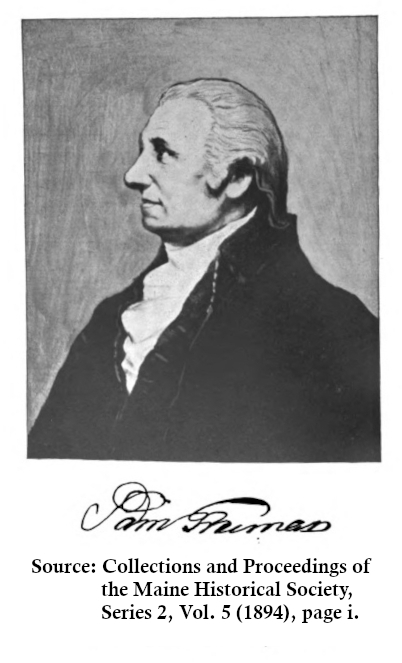
Died June 18, 1831
Samuel Freeman was a remarkable figure in his day.
At the age of just 31, he was named to the town's Committee of Correspondence to reply to Boston's call for support in the aftermath of the “Tea Party” of December 1773. He was subsequently named a delegate to the Massachusetts Provincial Congress, of which he became the secretary.
Freeman served as clerk of the Cumberland County court for 46 years, during which time he also served multi-year terms as U.S. Postmaster, Register of Probate, Judge of Probate and town selectman. An early advocate of statehood for Maine, Freeman was a member of committees formed in both 1794 and 1807 to advance the issue, and in 1819, he was a signer of the petition which prompted the Massachusetts legislature to authorize Maine's constitutional convention.
Beyond governmental affairs, Freeman was for many years an Overseer of Bowdoin College. He established the town's first library (in 1785), He was elected the first president of Maine's first bank (in 1802), the first president of the town's foreign mission society (in 1812), and the first secretary of the Peace Society of Maine (in 1817). In 1825, at the age of 82—in recognition of his decades of service as deacon—Freeman was given the honor of laying the cornerstone for the “new” First Parish Church, which stands at the head of Temple Street today.
Finally, a fact about Freeman unnoticed in any contemporary account is his connection to the establishment of the Abyssinian Meeting House. Although the timing may have been entirely coincidental, it is interesting that just two months after Reuben Ruby and four other prominent Black citizens published a letter asking for support in their endeavor to erect “for their own use a suitable house for public worship,” Samuel Freeman sold Ruby the land upon which the Abyssinian Meeting House was soon built.
When Freeman's first wife, Mary Fowle, died, in 1785, she left Samuel with three children ages 7, 4, and 2. A year later, Freeman married Elizabeth (Ilsley) Jones, whose husband had died 5 years earlier. Together Samuel and Elizabeth had six children, all but one of whom married and moved away from Portland.
It's unknown just when the Freemans acquired the family lot in Eastern Cemetery, but the first interments there were of Mary (Fowle) Freeman (slate stone at plot G110) and her mother-in-law Mary (Wright) Freeman (slate stone at plot G110), who died within 2 weeks of each other in January of 1785. The final three were of Samuel himself, his second wife, Elizabeth, and their 40-year-old son Samuel Dean Freeman (broken marble stone at plot G124), all of whom passed away in 1831.
In light of his many contributions to the civic and social life of his time, Samuel Freeman was significantly more than the simple marble marker at his gravesite would have today's visitors to Eastern Cemetery understand.
Bio provided by Larry Glatz.
The Samuel Freeman Find a Grave entry has a photo of his marble headstone in Eastern Cemetery.
Last update: July 2026