Tour Stop 3: Pine Tree, Commemorative Boulder, Mary Green, Samuel Moodey
Watch your step as you walk through the stones. Sunken spots, iron posts, small markers are all tripping hazards! Also, please never step backwards unless you double-check what you're stepping on first.
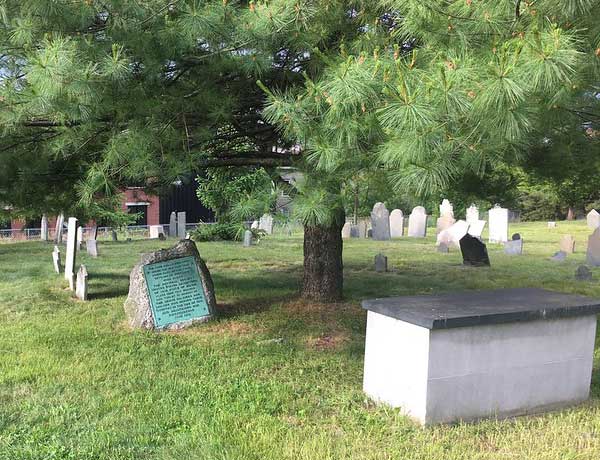
War of 1812 boulder and Smith box tomb under the pine tree
(full-size image of the trio on Flickr)
The pine tree shades a commemorative War of 1812 boulder and the box tomb for Reverend Thomas Smith and his family. There once was a huge pine tree on this spot that mariners used to confirm the location of the Portland waterfront as they sailed into Portland harbor. It blew down in a hurricane in 1815, and has been replaced a few times more over the years.
Find Mary & Samuel
After you read the plaque on the boulder, look to your left and you’ll see the back (uncarved) sides of 2 slate markers. Step around to the front of them, so you can read their inscriptions.
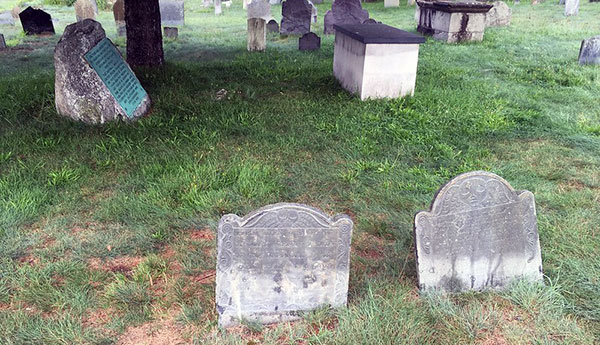
Mary Green and Samuel Moodey markers
(full-size image of the Green and Moodey markers on Flickr)
The marker on the left is for Mary Green who died in 1717. Though she was not the first buried in the cemetery, her stone is carved with the oldest death date. To the right, is the 1729 marker for Major Samuel Moodey, who resettled Portland in 1713, after conflicts with native Americans had left the town without English settlers for 20 years. Moodey was married to Mary Green’s sister, Esther. Note the similarity in carving between the 2 markers: a fancy border and a "death's head" or winged skull.
Later Read
The Moodys at Eastern Cemetery—a paper by Ron Romano
Continue to Stop 4: Stephen Larrabee
Turn away from the Green and Moodey markers, and walk a few paces in parallel with the fence line for 2 rows. Look to your right for a small slate marker near the leafy tree. You have reached Stop 4, the Stephen Larrabee marker.