Tour Stop 5: Proctor Children, Great Fire
Watch your step as you walk through the stones. Sunken spots, iron posts, small markers are all tripping hazards! Also, please never step backwards unless you double-check what you're stepping on first.
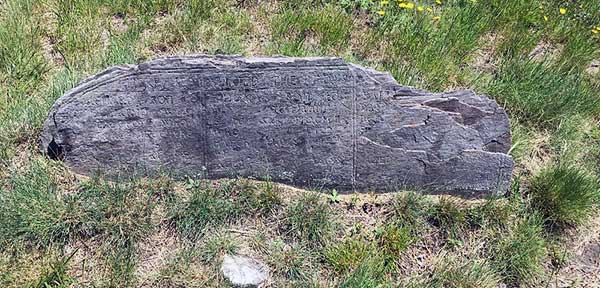
Proctor marker (full-size image of the Proctor marker on Flickr)
John Proctor was the first man hanged for witchcraft in Salem, Massachusetts, in 1692. His grandson Samuel moved to Portland, and 3 of Samuel’s children are memorialized on this marker. Sary, Thomas, and Richard Proctor died between 1741 and 1748, all under age 10. This marker is easy to miss, so look closely to see the inscribed names and dates for these children of a famous great-grandfather.
Side Note
When you’re finished reading the inscriptions on the Proctor stone, look up and forward all the way to the far corner of the cemetery. That is the patch of land set aside for burial of Black people in Portland. While the majority White Protestant residents claimed the burial plots closest to the entrances to the burying ground, those who were Black or pracited other religions were segregated to the far back corners of the cemetery. We will visit the area reserved for Black Portlanders later in the tour.
Great Fire Impact
Now, look to your right and find the chain link fence that runs along the back edge of the cemetery. The imposing stone wall upon which the fence sits was built after Portland’s great fire of 1866, which destroyed almost all of the buildings in this area. You are looking at what once was the front of the burying ground—everyone entered along this edge which had a gentle slope down into town. After the great fire, the town carved away the hillside and front border of the cemetery (along with the cemetery entrances) in order to extend Federal Street. The retaining wall was built, the fence was put up, and access from this side was completely eliminated. The orientation of the cemetery completely flipped from front to back, and the front entrance became the Congress Street gate where you entered.
Continue to Stop 6: Stephen and Tabitha Longfellow
From the Proctor marker, turn left. Carefully walk through the stones past a deteriorated brownstone monument and a recently-repaired box tomb. From there, turn right, and walk ahead until you see 2 tall illegible marble markers. Take a sharp left there. You have reached Stop 6, the Longfellow markers.