Tour Stop 7: Tombs of Captain Burrows, Captain Blyth, Lt. Waters (War of 1812)
Watch your step as you walk through the stones. Sunken spots, iron posts, small markers are all tripping hazards! Also, please never step backwards unless you double-check what you're stepping on first.
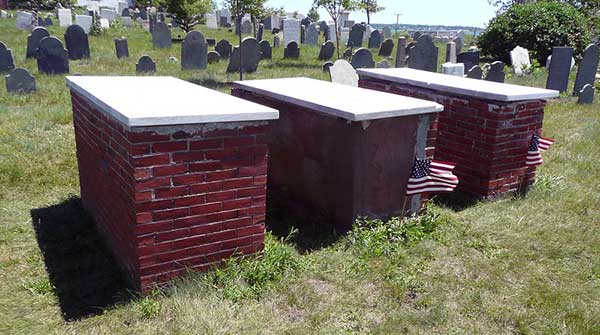
Burrows, Blyth, Waters box tombs (full-size image of the tombs on Flickr)
Perhaps the most famous men buried at Eastern Cemetery are US Captain William Burrows and British Captain Samuel Blyth. Both young men died on September 5, 1813, in the battle between the HMS Boxer and USS Enterprise just north of Portland. As France and Britain were fighting for world domination, the young nation of the United States was caught in the middle. Captain Blyth had positioned the Boxer to block US access to Canada for trade. Captain Burrows sailed the Enterprise to clear the way. The battle did not last long—Blyth was killed very quickly, while Burrows suffered a few hours with a mortal wound—long enough to learn that they had won the battle. The captains were buried side-by-side, and were joined by the Enterprise's Lieutenant Kervin Waters in 1815. The 3 brick box tombs—like all other box tombs at Eastern Cemetery—do not hold the remains of the deceased; they were buried underground and topped with the box tombs as monuments.
Side Note
These box tombs are only 3 of the more than 200 markers for veterans in the Eastern Cemetery. Decorated with private or government-issued markers, veterans here served in conflicts from the Revolutionary War to the Civil War.
Later Reads
- The Captains of the Boxer and the Enterprise
- Military Markers in Eastern Cemetery
Continue to Stop 8: Wadsworth Monument, Adams Children
Immediately beside (south) of the Waters tomb is a tall pedestal monument made of granite, marble, and sandstone. You have reached Stop 8, the Wadsworth monument.