Tour Stop 1: Dead House, City Tomb
Watch your step as you walk through the stones. Sunken spots, iron posts, small markers are all tripping hazards! Also, please never step backwards unless you double-check what you're stepping on first.
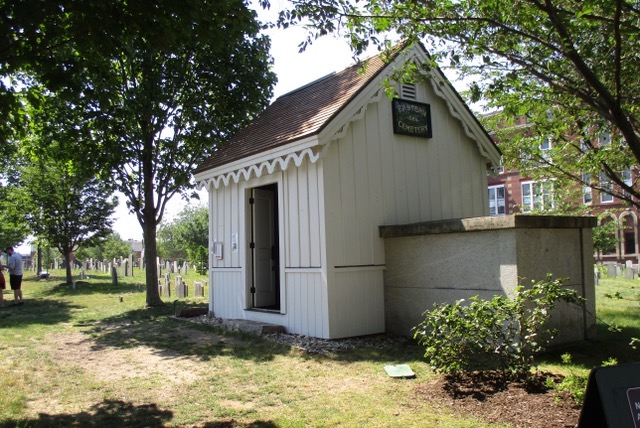
Dead House and City Tomb (by Ron Romano)
In many New England colonial cemeteries, in the winter, bodies of those who died were stored in a “dead house” until spring thaw allowed for digging. The Eastern Cemetery's Dead House, now used as a tool shed, was built in 1873 and is not the first. This area of the cemetery was private property until 1795, so earlier dead houses would have been found in the older (back) section of the cemetery. The granite box attached to the right of the Dead House covers the stairway down into the City Tomb, which was constructed in 1849 and used for about 50 winters to hold the coffins of Portland’s dead until spring.
Side Note
The land, from Congress Street to the flagpole, was originally the private field of Portland’s first minister, Reverend Thomas Smith (1702–1795) and is considered the new part of the cemetery. It was deeded to the town upon Smith's death and provided much-needed burial space since the original part of the cemetery was near capacity. Note the large brick building. Originally the North School, it was built 1867, and has been converted into apartments.
Later Read
Continue to Stop 2: Alden Monument
Walk to the flagpole along the path known as Funeral Lane. As you approach the flagpole, look right to find a very tall pink granite monument.